
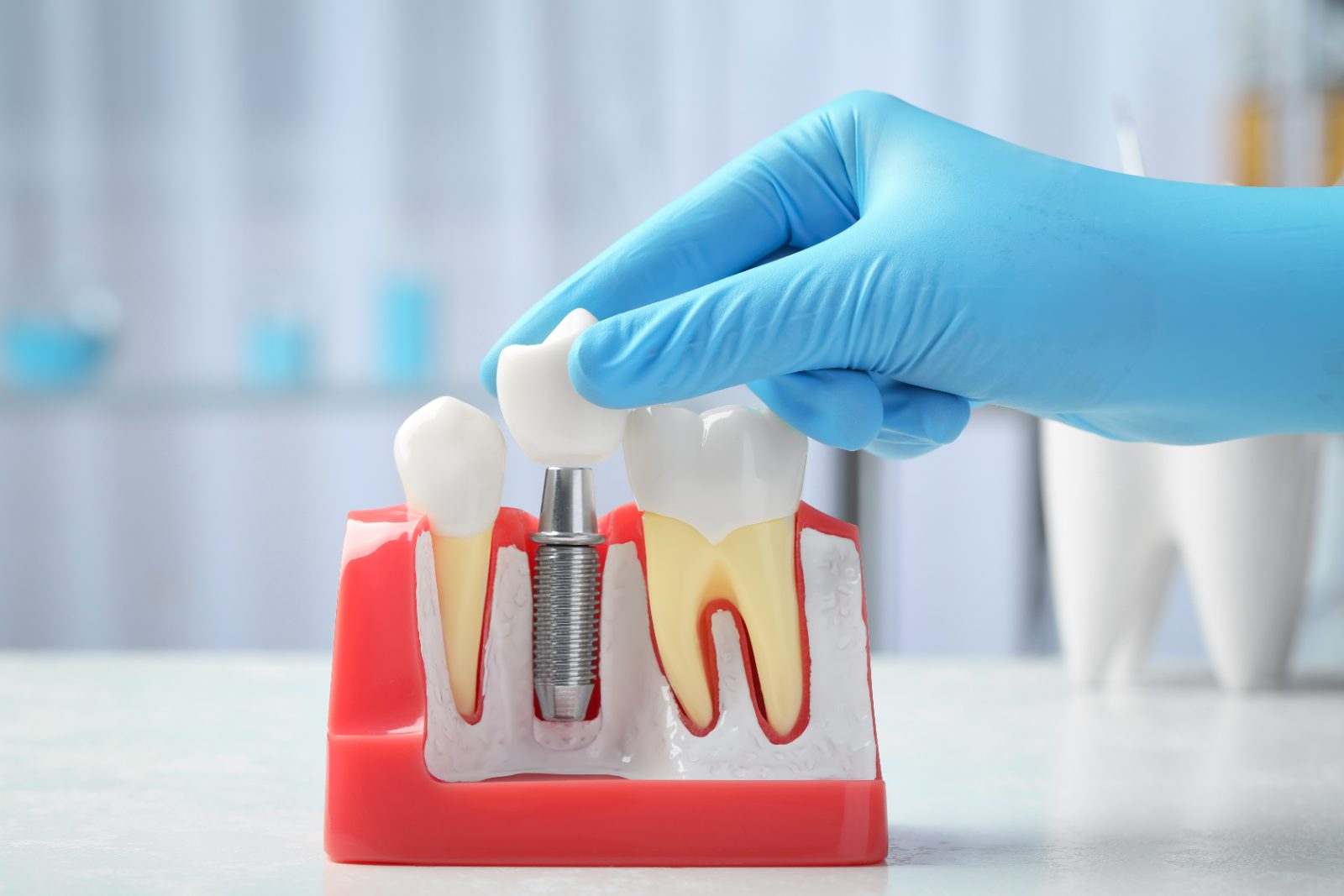
A missing tooth leaves more than a gap in your smile. Over time the opposing tooth drifts out of place, the neighbouring teeth tilt into the space, and you start chewing on one side. That’s why the decision to get an implant is usually about function before it’s about looks.
A panoramic X-ray to assess the bone in detail and build your personal plan
The titanium implant is placed in the jaw under local anaesthetic
The bone gradually bonds with the implant; how long this takes varies from person to person
Once healing is complete, a porcelain crown finishes the treatment

At Ayla Dent, every implant patient has a digital panoramic X-ray first, so we can study the jawbone in detail. Getting this right means the plan is built correctly from the start. The procedure is done under local anaesthetic, which is there to keep you as comfortable as possible during the treatment.
Colour and shape are matched to your own teeth
With good care and regular check-ups, it can serve you for many years
Helps the bone where the tooth was missing stay active
It doesn't move like a removable denture; it stays fixed in place
No need to file down the healthy teeth next to the gap
The aim is to give you back proper chewing function
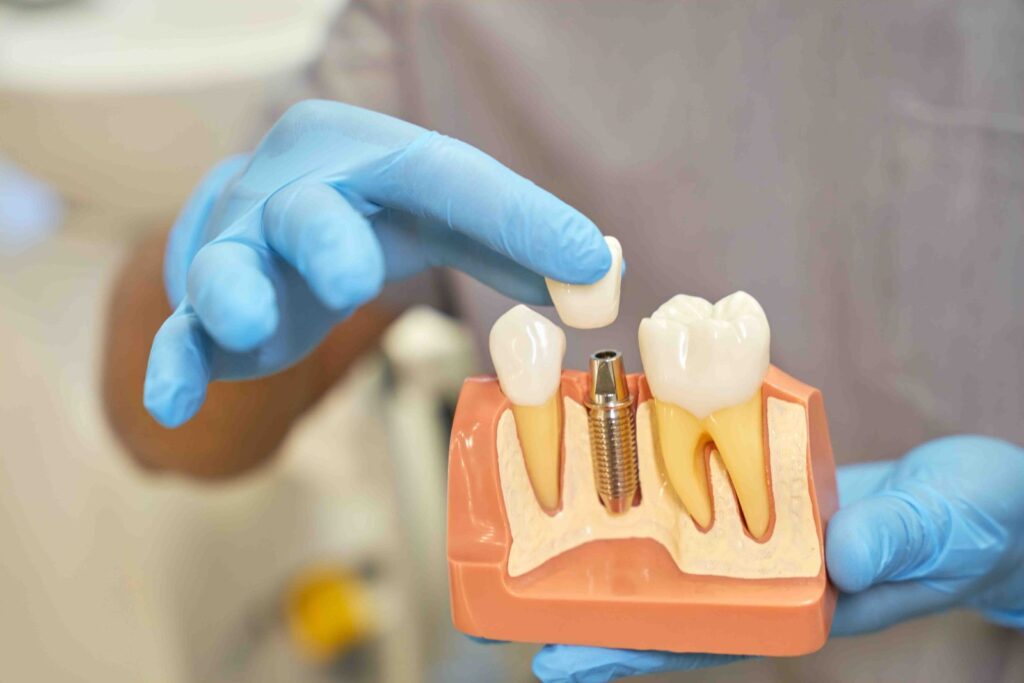
An implant has three parts.
The implant — a titanium screw placed in the jawbone. It takes the place of the tooth’s root.
The abutment — a connector that sits on the implant and holds the visible tooth.
The restoration — the part you see. For one missing tooth it’s a crown; for several it can be a bridge.
The tooth isn’t fitted the moment the implant goes in. The bone first needs time to grow around it, a process called osseointegration. How long that takes depends on bone density, which jaw is treated and where; the lower jaw usually has denser bone than the upper.
Which implant and restoration system is used depends on your mouth, the number of missing teeth and the bone. At Ayla Dent we use CE- and FDA-approved implant systems.
Implants are suitable for adults whose mouth and general health allow it. Having a missing tooth isn’t enough on its own. At the examination we look at the amount and quality of jawbone, gum health, the neighbouring teeth, your bite, where the gap is, your medical history and any medication you take.
Some patients need gum treatment or a procedure to build up the bone before the implant. That doesn’t rule an implant out; it just changes the order of steps.
If there’s advanced bone loss, uncontrolled diabetes, heavy smoking or certain medications, your dentist may want further assessment. None of these automatically rules you out, but they do shape the plan.
We start with an oral examination and a panoramic X-ray, looking at the gap, the bone, the gums and the neighbouring teeth. This is where we plan how many implants you need, where they go and what restoration will sit on top.
This is done under local anaesthetic. The gum is opened, a space is prepared in the bone, the implant is placed and the area is closed. A single implant usually doesn’t take long; the number of implants and the site affect the time.
The anaesthetic is there to keep pain to a minimum during the procedure. You may feel pressure or vibration, which is normal.
Now the bone grows around the implant, and the area shouldn’t be put under load. How long this takes varies; bone quality, location and the treatment plan all play a part.
You don’t have to go without a tooth in the meantime — where suitable, a temporary restoration can be made.
Once healing is complete, we take impressions and make the tooth that goes on the implant, matching its colour, shape and bite to your other teeth.
The procedure is done under local anaesthetic, which aims to keep pain to a minimum while we work.
In the first few days you may have mild pain, swelling or tenderness. That’s a normal reaction after any surgical procedure and it varies from person to person. Following your dentist’s medication and aftercare advice will help you through it.
If you have severe or worsening pain, marked swelling or anything unexpected, contact your dentist.
The total time is made up of two things: the surgical appointments and the healing in between. The surgery itself is usually short; it’s the healing that takes time.
What affects the timeline: the number of implants, which jaw and area, the condition of the bone, whether an extra step like a bone graft is needed, and the type of restoration.
So the answer to “how long will it take?” comes after your examination and X-ray, and it’s specific to you.
If there isn’t enough bone to support an implant, a bone graft or another bone-building procedure is considered first. Sometimes the graft is done in the same session as the implant; sometimes it’s a separate step beforehand.
The right approach depends on the area, how much bone there is and where the implant is planned.
“I don’t have enough bone, so it won’t work for me” isn’t something anyone can say before an examination. Low bone volume can often be handled by adding a step to the plan.
For a single missing tooth, an implant has one clear advantage over a bridge: the healthy teeth on either side are left alone. A bridge needs those teeth filed down for support; an implant doesn’t.
One implant goes into the gap and a crown is made for it. If the neighbouring teeth and the bone are suitable, this is the most commonly chosen option.
You don’t need one implant per missing tooth. If three teeth are missing, a bridge on two implants may be enough; the number depends on the restoration plan, not just on how many teeth are gone.
Where the gaps are, the distance between them and the bone all shape the decision. The aim is solid support with as little surgery as possible.
If you’ve lost all your teeth, there are two routes. One is a fixed implant-supported denture: a set of teeth on a number of implants that stays in your mouth. The other is an implant-retained removable denture: it clips onto implants but can be taken out for cleaning.
The difference comes down to comfort, cleaning habits, bone condition and budget. Which suits you is decided after an examination and X-ray.
Terms like “All-on-4” and “All-on-6” describe full-arch restorations on a set number of implants. Whether they suit you is assessed case by case.
The key difference is where the support comes from. An implant is anchored in the bone; a bridge relies on the neighbouring teeth.
A bridge means filing down the teeth beside the gap. If those teeth are healthy, that’s a real loss. But if they already have large fillings or crowns, a bridge can make good sense.
The decision weighs the neighbouring teeth, the bone, how many teeth are missing, gum health and treatment time together. A bridge is usually finished sooner; an implant leaves the neighbouring teeth untouched.
What you see isn’t the implant itself but the restoration on top and the gum around it.
At the back of the mouth this is usually straightforward. At the front, the gum line, the colour of the neighbouring teeth and your smile line all matter, so planning is more delicate. The colour, shape and size of the new tooth are matched to your own.
It varies from person to person and depends largely on how the implant is cared for afterwards.
What matters most: daily oral hygiene, gum health, regular check-ups, smoking, clenching or grinding, and the condition of the restoration.
An implant can’t decay, but the gum and bone around it can become diseased. What gum disease is to a natural tooth, peri-implantitis is to an implant. That’s why follow-up visits are part of the treatment, not an optional extra.
For the first few days, avoid putting pressure on the area and steer clear of hard or very hot food. Keep up your oral hygiene the way your dentist shows you, and don’t skip check-ups during healing.
Smoking slows healing; stopping or cutting down during this period makes a direct difference.
Care doesn’t stop once the tooth is fitted. Regular check-ups and cleaning are what keep an implant healthy in the long run.
As with any surgery, implants carry some risk. The implant not bonding well with the bone, infection, gum problems, excessive biting forces and poor aftercare can all affect the result.
These risks are assessed at the examination and the plan is built around them. Following the aftercare and check-ups you’re given is the most important thing you can do to reduce them.
The cost of an implant isn’t a single line item. The total depends on the implant system, the number of implants, the bone, whether extra steps like a graft are needed, the type of restoration and the overall scope of treatment.
That’s why comparing on “implant price” alone can be misleading. What you should compare is the full treatment plan, including the surgery and the tooth on top.
At Ayla Dent, after your examination and X-ray we’ll go through the suitable options and their costs with you.
Ayla Dent is on Birlik Caddesi in the Yavuz Selim neighbourhood of Bağcılar. We’re open Monday to Saturday, 9:00–19:00, and closed on Sundays.
Implant planning starts with an examination and a panoramic X-ray. We don’t just look at the gap: the bone, gums, neighbouring teeth and restoration needs are assessed together. The goal isn’t simply to fill a space but to plan for your whole mouth.
Is an implant right for you, is there enough bone, how many will you need? You’ll get clear answers after your examination.
Yes, but smoking slows healing and raises the long-term risk. Your dentist will ask you to stop or cut down while you heal.
If your blood sugar is well controlled, most patients can. Uncontrolled diabetes makes healing harder, so it needs to be managed first. Please tell us about any medication you take.
Not necessarily. Where suitable, a temporary restoration can be made for the healing period. We’ll discuss this when planning.
Most people are back to their normal routine the next day. If your job is physically demanding or you’ve had several implants, your dentist may suggest a few days’ rest.
In some cases it can be done in the same session as the extraction. If there’s infection or the site isn’t suitable, we wait for it to heal. The X-ray and examination decide.
An implant that has bonded with the bone doesn’t simply fall out. If the gum and bone around it become diseased, its support can weaken; regular check-ups and good oral care prevent that.
Titanium, the material used in implants, is known to be well tolerated by the body. If you have a known metal allergy, please tell us at your examination.
There’s no upper age limit; your general health is what counts. At the younger end, the jaw needs to have finished growing, which is usually after the teenage years.
Titanium implants don’t prevent an MRI. Still, let the imaging team know you have one beforehand.
Ayla Dent provides implants and other dental treatments in the Yavuz Selim neighbourhood of Bağcılar. Before any treatment, we assess your options with an examination and X-ray.