
If you are thinking about braces or clear aligners, you may wonder how they affect the jaw joint.
This question matters most to people who already have jaw clicking, a jaw that shifts to one side, or pain when opening the mouth. Will orthodontic treatment make it worse, or fix it?

The link between orthodontics and the temporomandibular joint (TMJ) has been studied for decades. According to NIDCR, research does not support the belief that a bad bite or orthodontic treatment such as braces causes TMJ disorders, and there is not enough evidence that bite-changing treatments fix them.
What Is Orthodontics?
Orthodontics is the branch of dentistry that deals with the position of the teeth and how the upper and lower jaws meet.
Treatment can use fixed braces, clear aligners or other appliances.
Its goals include straightening the teeth, correcting certain bite problems and supporting oral health.
You can find general information about orthodontic treatment at Ayla Dent on our orthodontics page.
What Is the TMJ?
The temporomandibular joint connects the lower jaw to the skull.
When you talk, chew, swallow or open your mouth, the jaw joints and surrounding muscles work together.
Temporomandibular disorders (TMDs) are a group of conditions affecting the joint, the chewing muscles or related structures. They are not always caused by how the teeth are lined up.
Related reading: TMJ Disorder: Symptoms, Jaw Clicking and Joint Position
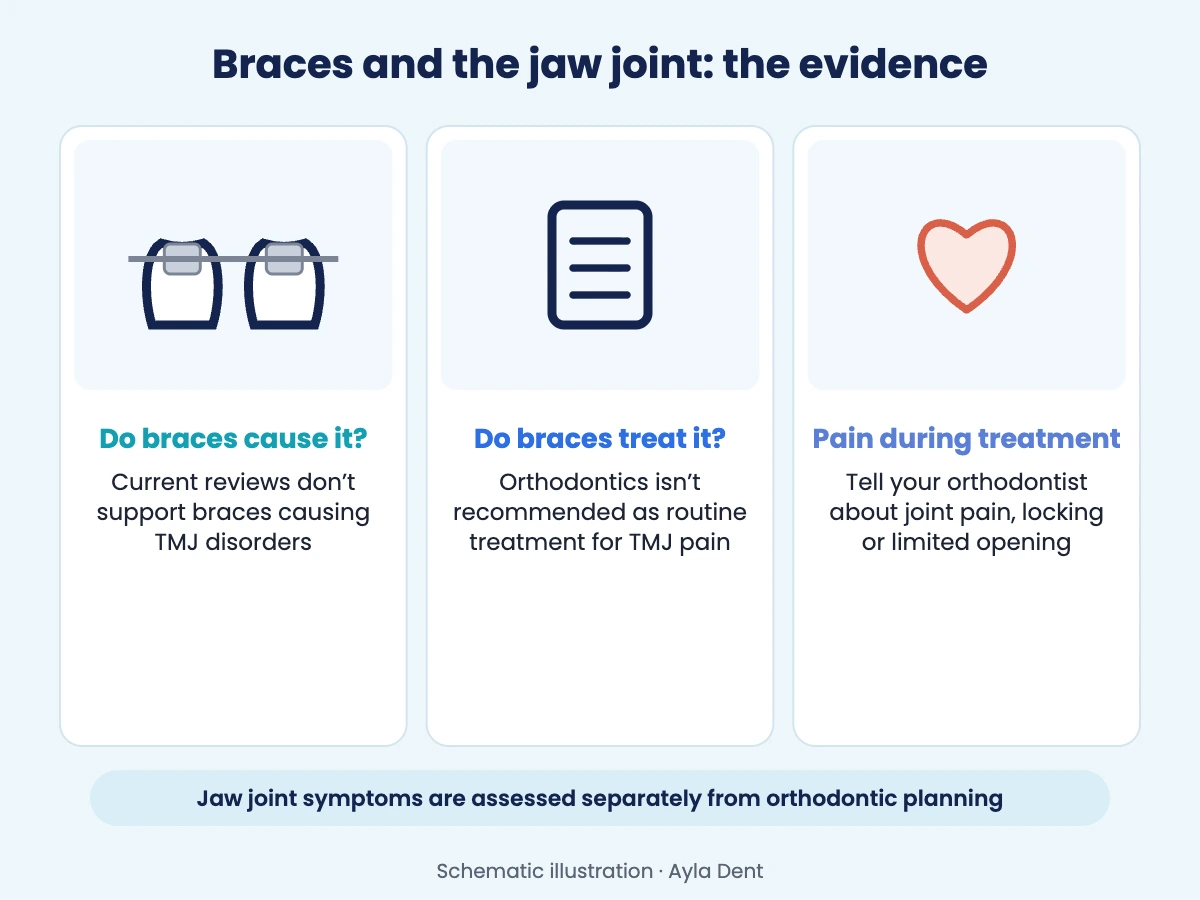
Do Braces Cause TMJ Problems?
Whether orthodontic treatment causes TMJ disorders was debated for many years.
Current scientific reviews do not support the view that braces or other orthodontic treatments cause TMJ disorders.
In the same way, crooked teeth or bite differences do not mean that a jaw joint disorder will develop.
Jaw joint problems are linked to a mix of biological, psychological and functional factors.
Can Orthodontic Treatment Relieve TMJ Pain?
Orthodontic treatment is not a routine treatment for TMJ pain.
A person can have both misaligned teeth and jaw joint pain. Having both does not prove that one causes the other.
Orthodontic treatment is planned around the alignment and bite, while jaw joint symptoms are assessed separately.
There is not enough evidence that permanently changing the bite relieves jaw joint pain.
What If You Get Jaw Pain During Orthodontic Treatment?
Temporary tooth soreness or pressure is common during orthodontic treatment.
That is different from pain coming from the jaw joint or chewing muscles.
Get an assessment if you notice:
- Ongoing pain in front of the ear or around the jaw joint
- Clearly limited mouth opening
- A jaw that locks
- Muscle pain that increases when chewing
- Jaw discomfort that keeps getting worse
The cause should be investigated rather than simply assumed to be the braces or aligners.
Do Clear Aligners Affect the Jaw Joint?
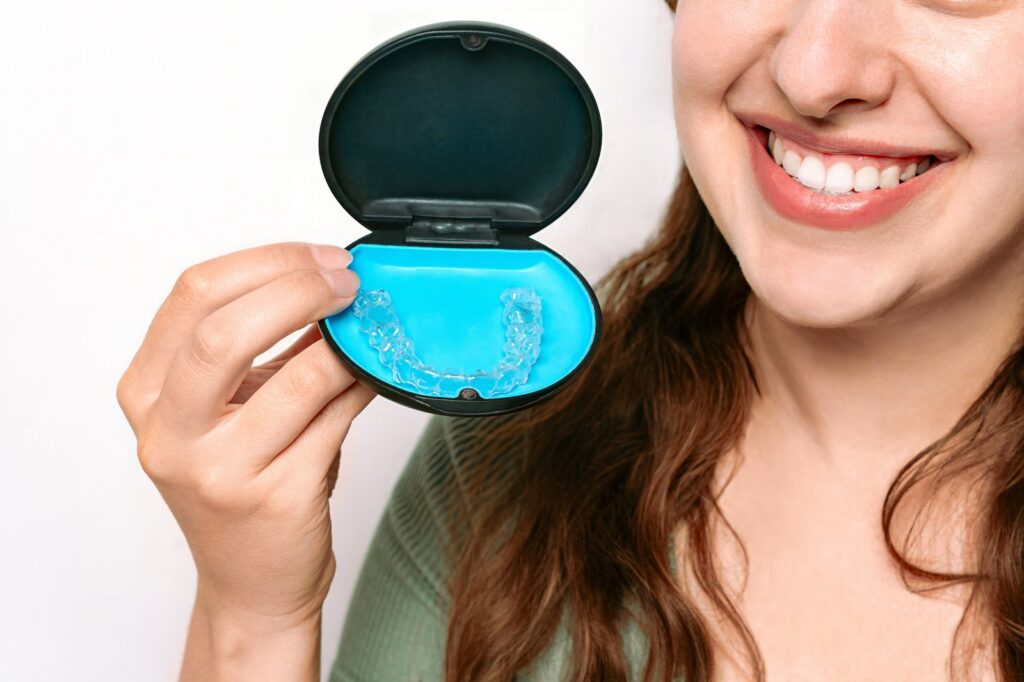
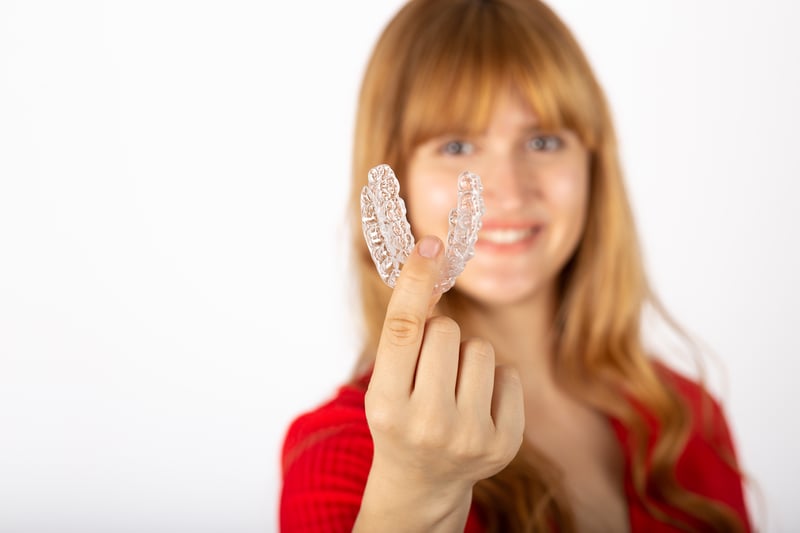
Clear aligners move the teeth in a controlled way, and changes in the bite are part of the treatment plan.
There is no evidence that aligners reliably treat TMJ disorders or reduce jaw joint pain in every patient.
For people with existing jaw joint problems, orthodontic planning should be individual.
Does Bruxism Affect Orthodontic Treatment?
Bruxism is clenching or grinding the teeth during sleep or while awake.
Because of the forces it puts on the teeth and restorations, a history of bruxism is useful information for the orthodontist.
However, orthodontic treatment cannot be expected to stop bruxism, and misaligned teeth are not considered its main cause.
Related reading: What Is Bruxism? Teeth Grinding Causes and Treatment
How Is the Jaw Joint Checked at an Orthodontic Consultation?
The orthodontist examines the inside of your mouth and how your teeth meet.
If you have jaw joint symptoms, they may also check your pain history, how wide you can open, joint sounds and the chewing muscles.
When needed, input from other specialists can be sought.
The aim is to separate the need for orthodontic treatment from any existing joint problem and plan accordingly.
Frequently Asked Questions
Can braces fix a jaw that shifts to one side?
A shifting jaw has different possible causes. Some bite problems can be corrected with orthodontics, but not every case of jaw shifting can be.
Can orthodontic treatment cause TMJ disorders?
Current scientific evidence does not support the view that orthodontic treatment causes TMJ disorders.
Can I get braces if my jaw clicks?
A click without pain is not, by itself, a condition that needs treatment. The need for orthodontics and any jaw symptoms are assessed together.
Are a night guard and a clear aligner the same thing?
No. A protective night guard and an orthodontic aligner designed to move teeth serve different purposes.
Related reading: Night Guard for Teeth Grinding: What It Does and How to Use It
Should my TMJ be checked before orthodontic treatment?
If you have jaw pain, locking or limited movement, these should be assessed while planning orthodontic treatment.
Conclusion
Orthodontics and the jaw joint are part of the same chewing system, but the relationship between them is not a simple cause and effect.
Orthodontic treatment is planned around your teeth and bite. Jaw joint problems are diagnosed and managed in their own right.
This article is for general information only and is not individual diagnosis or treatment advice.
Sources
- NIDCR – Temporomandibular Disorders (TMDs): https://www.nidcr.nih.gov/health-info/tmd
- NIDCR – Bruxism: https://www.nidcr.nih.gov/health-info/bruxism