
If a tooth has been missing for a long time, the jawbone in that area can shrink. That is why many people looking into implants ask the same question: “My jawbone has receded. Can I still get a dental implant?”
A dental implant needs enough bone around it to be stable. Having less bone does not automatically rule implants out, but it does not mean they are always possible either. The amount of bone, the anatomy of the area and your general health are assessed before any option is recommended.

Why Does an Implant Need Bone?
A dental implant is an artificial tooth root placed in the jawbone to replace a missing tooth.
To work, the implant has to bond with the surrounding bone. This biological process is called osseointegration.
The height, width and shape of the bone where the implant will go are key parts of treatment planning.
For an overview of how implant treatment works, see our dental implants page.
Why Does the Jawbone Shrink?
Bone loss in the jaw can have several causes.
A Tooth Missing for a Long Time
After a tooth is removed, the bone that supported it changes over time. Bone volume tends to decrease in areas where a tooth has been missing for years.
Gum Disease
Advanced periodontal (gum) disease can destroy part of the bone that supports the teeth.
Injury and Infection
Past injuries, some infections or earlier surgery can affect the shape of the jawbone.
Anatomy
In the back of the upper jaw, the position of the sinus can limit how much bone height is available for an implant.
Can You Get an Implant With Too Little Bone?
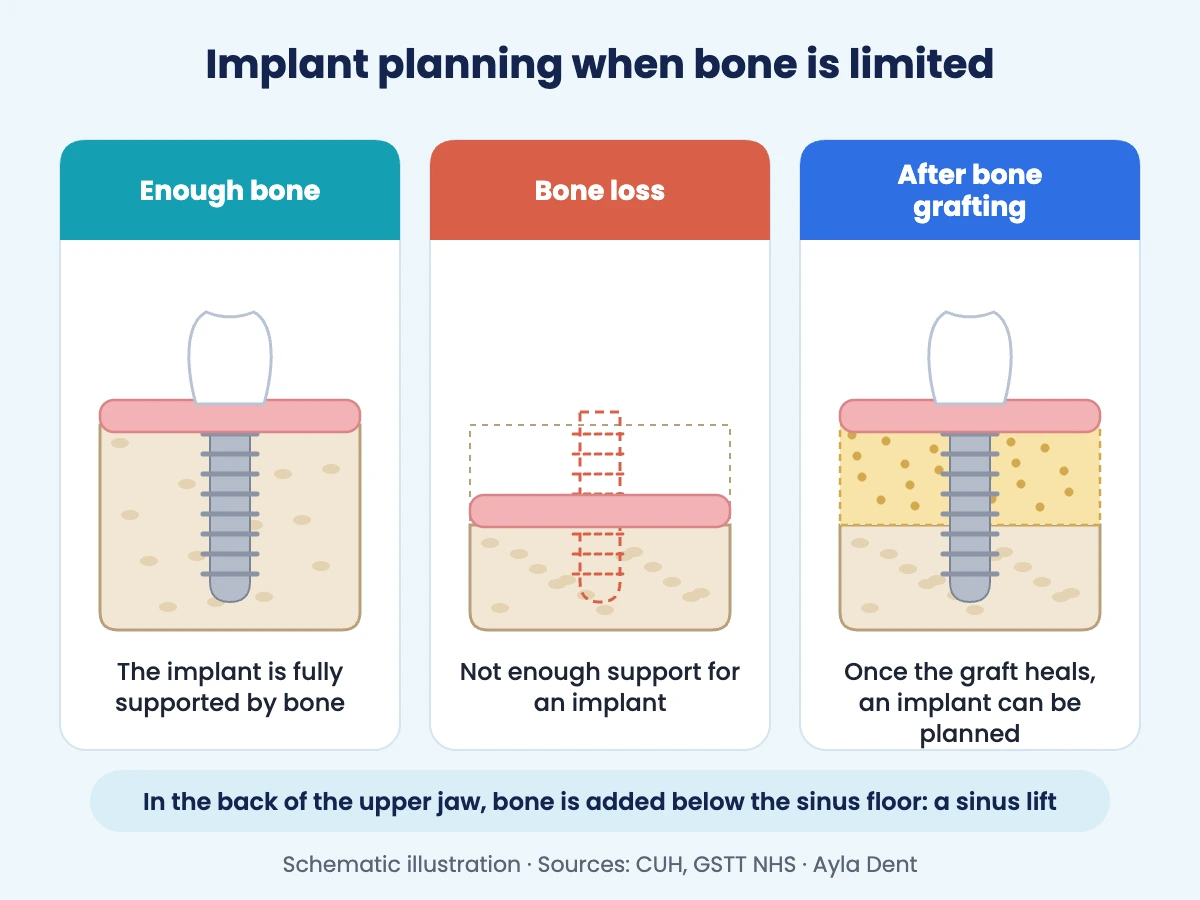
In some patients, bone augmentation (bone grafting) can create enough support for an implant.
Not everyone is suitable for grafting or for implants, though.
Whether treatment is possible is decided after a clinical examination and the right imaging, such as a 3D scan.
What Is a Bone Graft?
A bone graft adds material to an area where bone is missing so that new bone can form there.
Graft materials come from different sources and have different structures. The choice depends on the size of the defect and the procedure planned.
The aim is to help build enough bone to support an implant in suitable patients. A graft does not always produce enough bone, and it does not mean an implant can always be placed afterwards.
What Is a Sinus Lift?
A sinus lift is a surgical procedure that may be considered when there is not enough bone height in the back of the upper jaw.
It adds bone below the floor of the maxillary sinus to make room for an implant.
There are different techniques, sometimes called open and closed sinus lifts. The right one depends on how much bone is left, the anatomy of the sinus and the implant planned.
When Can the Implant Be Placed After a Bone Graft?
The grafted area usually needs time to heal.
In some patients, the implant can be placed at the same appointment as the graft. In others, the two steps are done separately.
Healing after a graft can take several months. The exact time depends on the technique, the size of the defect and how you heal.
Are There Options Without a Bone Graft?
For suitable patients, implants of different lengths or angles may avoid the need for grafting.
There are also specialised implant techniques for severe bone loss. These are not suitable for everyone and involve more complex surgical planning.
When implants are not suitable, a dental bridge or a removable denture should also be considered.
Related reading: Dental Implant vs Bridge: Key Differences

Frequently Asked Questions
Can everyone with bone loss get an implant?
No. Whether there is enough support for an implant has to be assessed individually.
Can an implant be placed without a bone graft?
If there is already enough bone, grafting may not be needed. This is decided after an examination and imaging.
Does jawbone grow back on its own?
Some natural healing can happen, but significant bone loss should not be expected to recover on its own.
Does a bone graft make treatment longer?
Yes. The graft may need extra time to heal, depending on the procedure and your situation.
Conclusion
Jawbone volume is an important part of implant planning. Having less bone does not automatically mean an implant is impossible.
Bone grafting, a sinus lift or other restorative options can be considered after a personal assessment.
This article is for general information only. Suitability for treatment can only be decided after a dental examination and the necessary imaging.
Sources
- Cambridge University Hospitals – Bone grafting for dental implants: https://www.cuh.nhs.uk/patient-information/bone-grafting-for-dental-implants/
- Guy’s and St Thomas’ NHS – Bone grafting for dental implants: https://guysandstthomas.nhs.uk/health-information/bone-grafting-dental-implants