
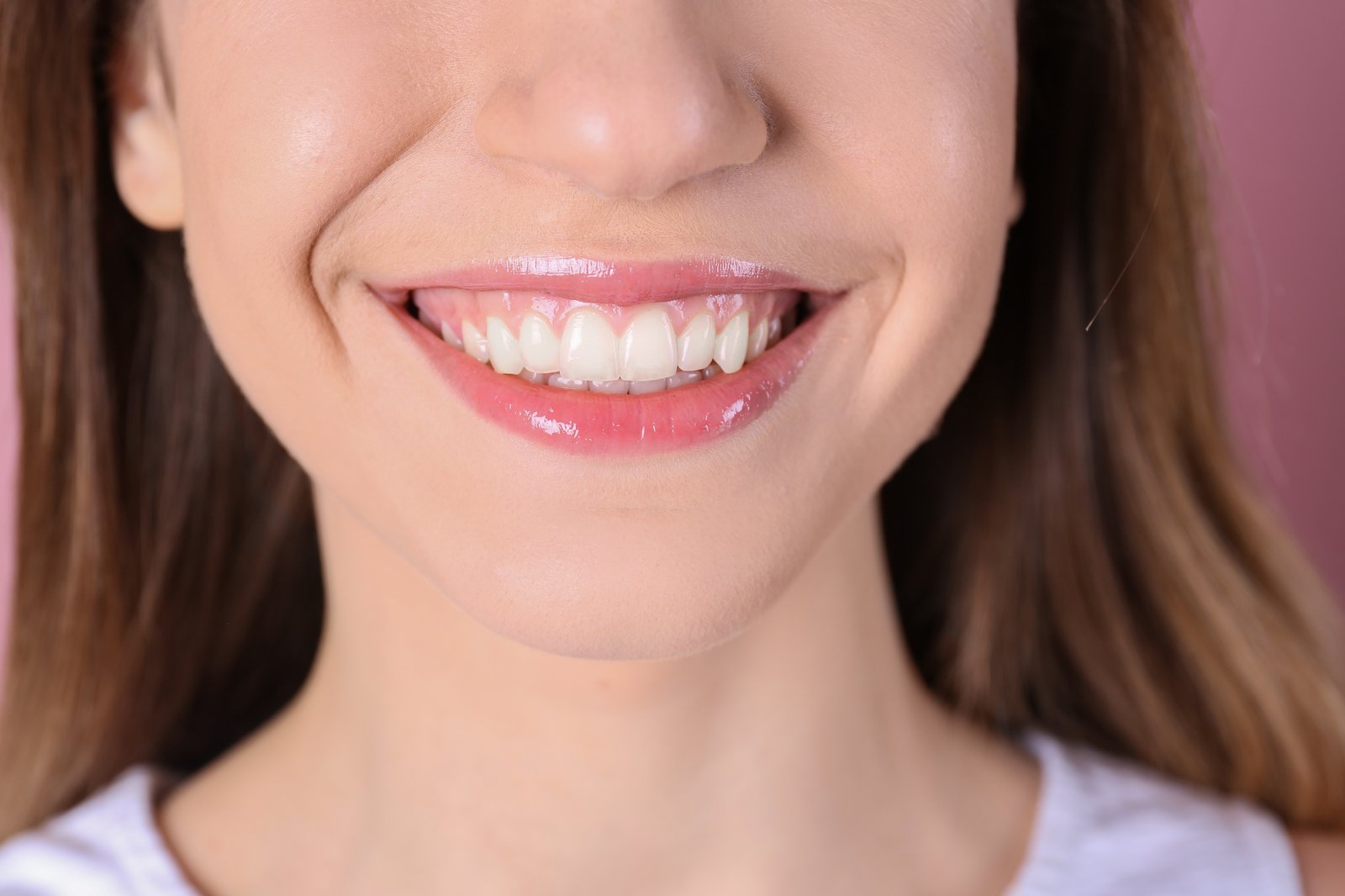
A gummy smile is when more of the upper gum shows than usual when you smile. The clinical term is excessive gingival display. It isn’t a disease, but for some people it’s the part of their smile that bothers them most.
A gummy smile has more than one possible cause, and the right treatment depends on which one it is. Teeth that look short, an upper lip that lifts too high, or an upper jaw that has grown too far downwards can all produce the same look. So treatment starts with finding the cause.
This guide explains what causes a gummy smile, the treatment options and what research shows about how long the results last.
What Counts as a Gummy Smile?
Showing 1–2 mm of gum when you smile is considered normal. As more gum shows, the smile starts to look gum-heavy. There’s no single cut-off. Some authors use more than 2 mm, others 3–4 mm.
It’s reported in about 10% of people aged 20 to 30 and is more common in women. It tends to lessen with age as the lips drop slightly (Brizuela and Ines, StatPearls).
What Causes a Gummy Smile?
Often, more than one cause is involved.
- Gum covering too much of the tooth (altered passive eruption): after a tooth erupts, the gum normally moves back a little. If that doesn’t happen fully, the gum covers part of the tooth, so teeth look short and gums look prominent.
- Hypermobile upper lip: the muscles that lift the lip are overactive, so the lip rises higher than usual when you smile.
- Short upper lip: a shorter lip leaves more gum exposed.
- Vertical maxillary excess: the upper jaw has grown too far downwards. This is a skeletal cause, usually confirmed with a cephalometric X-ray.
- Over-erupted front teeth: with a deep bite or tooth wear, the front teeth and gum can drift downwards.
- Gum overgrowth: certain medicines, inflammation or poor cleaning during braces can make the gums enlarge.
Why Diagnosis Comes First
The same look can have different causes, and each needs different treatment. If the lip is the issue, gum surgery alone may not be enough. If the gum is the issue, treating the lip won’t give a lasting result.
At the exam, the dentist usually checks:
- How much gum shows when you smile
- The length and proportions of your teeth
- The length of your upper lip and how far it lifts
- The distance between the gum and the underlying bone
- Your bite and jaw structure
Treatment Options

Gum Contouring (Crown Lengthening)
If the gum covers too much of the teeth, the extra tissue is removed to reveal their true length. If there’s enough distance between gum and bone, reshaping the gum (gingivectomy) may be all that’s needed. If the bone sits too close to the tooth, it may also need reshaping so the gum doesn’t grow back to where it was.
This is sometimes called pink aesthetics. It’s also used to make the gumline more even.
Botulinum Toxin Injections
For an overactive upper lip, small amounts of botulinum toxin can be injected into the muscles that lift it, so the lip rises less when you smile.
The effect is temporary. A systematic review reported an average reduction of about 4 mm in gum display two weeks after injection. The effect held for at least 8 weeks and may not return to baseline by 12 weeks. The authors also noted that the evidence is limited (Chagas et al., 2018). Injections are usually repeated at intervals.

Lip Repositioning
In this procedure, a thin strip of tissue is removed from the inside of the upper lip to limit how far it lifts when you smile.
A meta-analysis of 8 studies found that gum display fell by an average of 2.87 mm at 3 months, 2.71 mm at 6 months and 2.10 mm at 12 months. The authors say about 25% relapse can be expected after a year (Santos-Pereira et al., 2021). Techniques that also release the lip-lifting muscle fibres (myotomy) gave a greater reduction at 6 months.
Temporary swelling, bruising, lip tightness or numbness can follow surgery. Less often, stitches opening, a small salivary cyst or an uneven smile have been reported.
Hyaluronic Acid Filler
Some clinics inject hyaluronic acid filler beside the nose to limit how far the lip-lifting muscles pull. Evidence for this is still limited. The area has many blood vessels, so there’s a risk of vascular blockage, and it needs an experienced injector.
Orthodontic Treatment
If over-erupted front teeth are the cause, braces or aligners can move them upwards. Some gummy smiles can be corrected with orthodontics alone.
Jaw Surgery
When the cause is clearly skeletal, with the upper jaw grown too far downwards, orthognathic surgery may be considered. It’s a bigger procedure done in hospital and is generally reserved for severe cases.
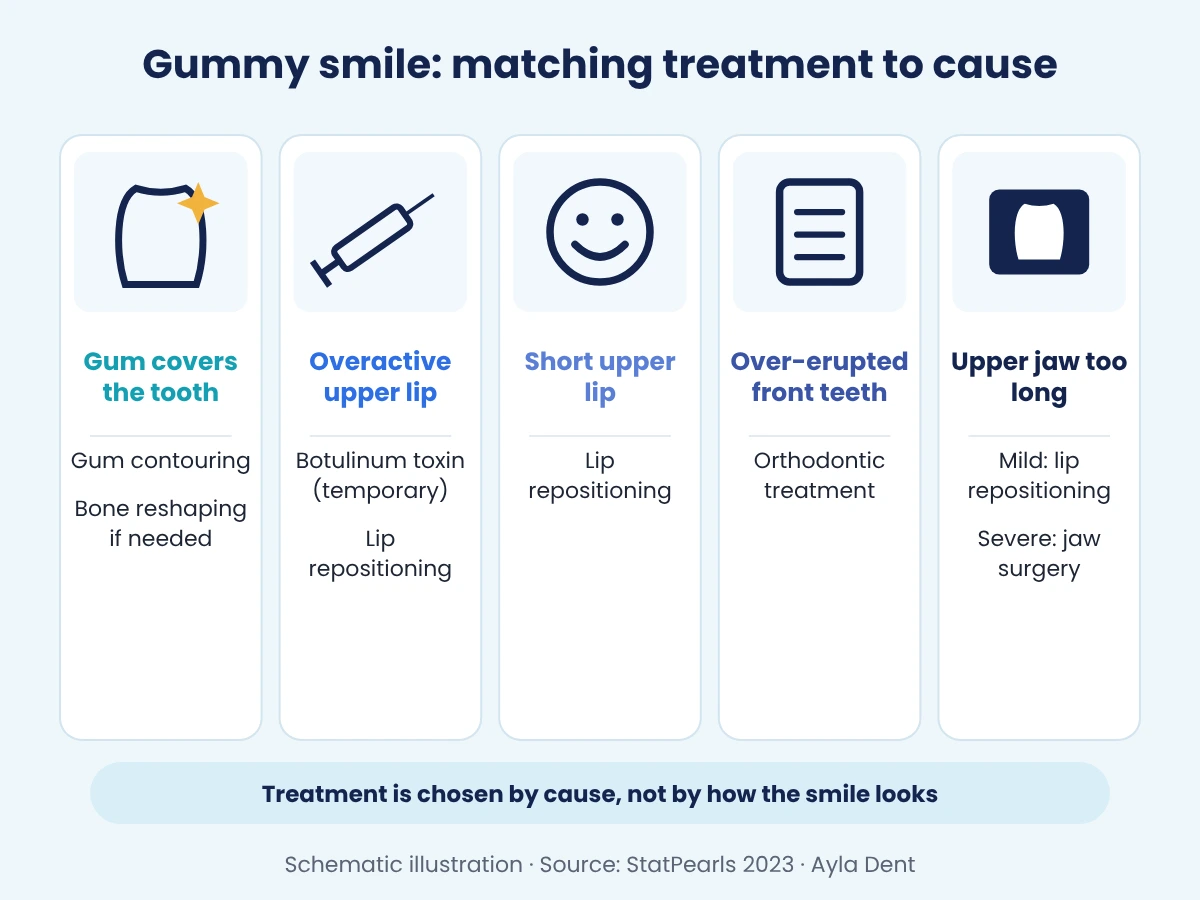
Matching Treatment to Cause
| Cause | Treatments to consider |
|---|---|
| Gum covering too much tooth | Gum contouring, with bone reshaping if needed |
| Hypermobile upper lip | Botulinum toxin, lip repositioning |
| Short upper lip | Lip repositioning |
| Over-erupted front teeth | Orthodontic treatment |
| Vertical maxillary excess | Lip repositioning for mild cases, jaw surgery for severe ones |
When several causes are involved, treatments can be combined. For example, gum contouring can be followed by veneers to refine tooth proportions.
Gummy Smile and Smile Design
The gumline is one of the foundations of smile design, because tooth length and shape are planned around it. If you’re considering veneers or crowns, adjusting the gums first usually makes the result more predictable.
Learn more in Veneers.
After Treatment
- After gum procedures, brush gently as your dentist advises.
- Some swelling and tenderness in the first days is common.
- After lip surgery, you may be asked to limit wide smiling and lip movement for a while.
- Regular check-ups and daily flossing help keep gums healthy.
Bleeding or swollen gums should be treated before any cosmetic work. See Bleeding Gums.
Frequently Asked Questions
Does a gummy smile go away on its own?
When it’s caused by gum covering the teeth, the gum may move back slightly in the teenage years, and lips drop a little with age. In adults, though, little change is expected unless the cause is treated.
Is botulinum toxin permanent?
No. The effect fades over a few months and needs repeating.
Is lip repositioning permanent?
The effect is long-lasting, but research shows some relapse within the first year.
Can gums grow back after contouring?
If the distance between gum and bone isn’t planned correctly, the gum can creep back. That’s why it’s measured before treatment.
Will veneers alone fix a gummy smile?
Usually not. Veneers change the shape of the teeth, but they don’t correct gum display caused by the lip or jaw.
Summary
A gummy smile can come from the gums, lip, teeth or jaw. Treatment depends on the cause and ranges from gum contouring and botulinum toxin to lip repositioning and orthodontics. Some treatments are temporary or may partly relapse over time.
The right approach is planned once the cause has been identified at an exam.
This article is for general information. It does not replace an examination.
Sources
- Brizuela M, Ines D. Excessive Gingival Display. StatPearls. Treasure Island (FL): StatPearls Publishing; 2023. https://www.ncbi.nlm.nih.gov/books/NBK470437/
- Chagas TF, Almeida NV, Lisboa CO, Ferreira DMTP, Mattos CT, Mucha JN. Duration of effectiveness of Botulinum toxin type A in excessive gingival display: a systematic review and meta-analysis. Braz Oral Res. 2018;32:e30. https://doi.org/10.1590/1807-3107bor-2018.vol32.0030
- Santos-Pereira SA, Cicareli ÁJ, Idalgo FA, Nunes AG, Kassis EN, Henriques JF, Bellini-Pereira SA. Effectiveness of lip repositioning surgeries in the treatment of excessive gingival display: A systematic review and meta-analysis. J Esthet Restor Dent. 2021;33(3):446–457. https://doi.org/10.1111/jerd.12695