
A toothbrush cleans the front, back and biting surfaces of your teeth. What it often misses are the tight spaces where two teeth touch, and that is where plaque and food tend to collect.
Dental floss cleans between the teeth and along the gum line, where a brush cannot reach. Used with the right technique, it can help lower the risk of gum inflammation.
For the bigger picture of daily oral care, see: Daily Oral Care Guide
What Does Flossing Do?
Floss removes plaque and food from between the teeth. Plaque that is not cleaned away regularly can contribute to gum inflammation, tooth decay and bad breath.
A 2019 Cochrane review found that flossing in addition to brushing may reduce gum inflammation compared with brushing alone. The review rated the certainty of this evidence as low.

How to Floss
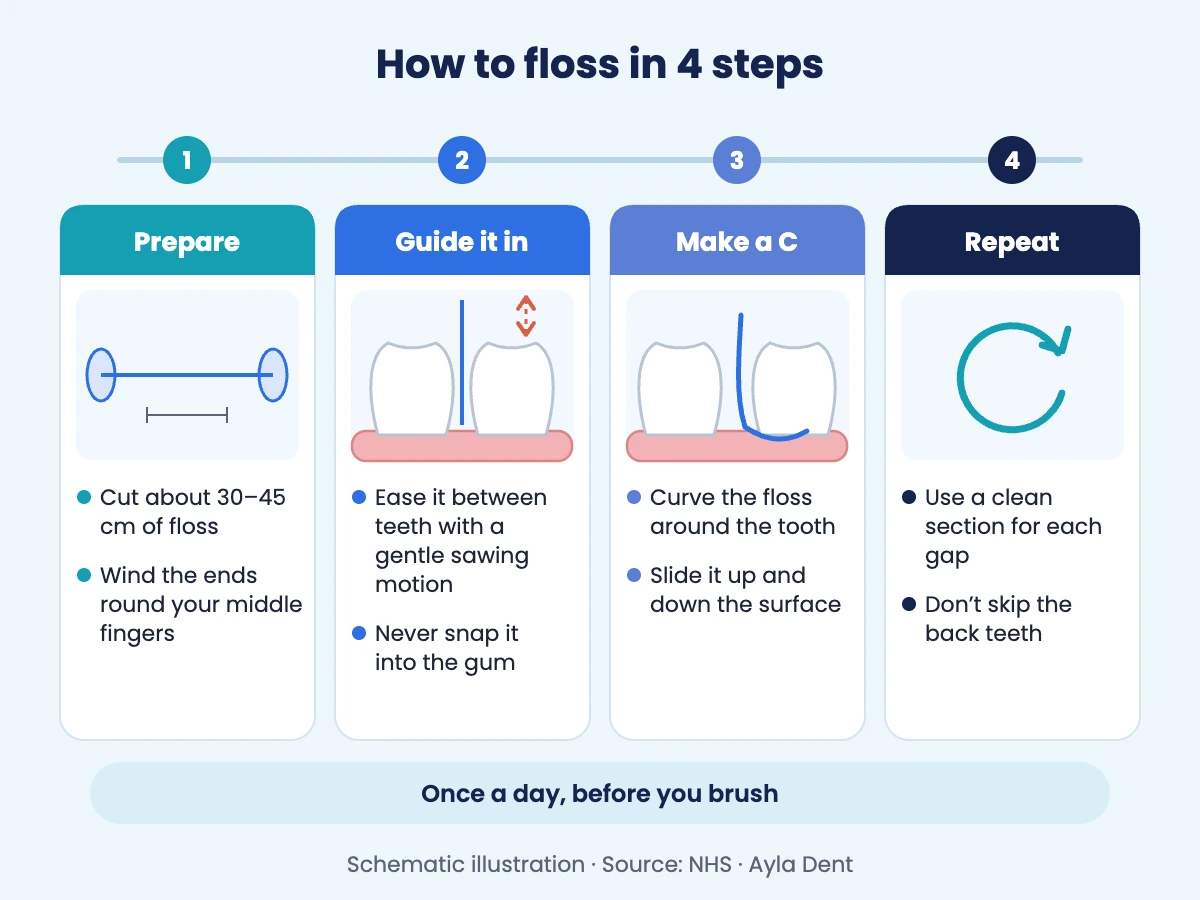
- Break off about 30–45 cm of floss.
- Wind most of it around the middle finger of one hand and the rest around the middle finger of the other.
- Hold a 3–4 cm section tight between your thumbs and index fingers.
- Ease the floss between two teeth with a gentle back-and-forth motion. Do not snap it into the gum.
- At the gum line, curve the floss into a “C” shape around the tooth.
- Move it up and down along the side of the tooth, then repeat on the neighbouring tooth.
- Use a clean section of floss for each gap.
Do not forget the back surfaces of your last teeth.
When and How Often Should You Floss?
Cleaning between your teeth once a day is recommended. The NHS suggests flossing before brushing, so that anything you loosen is brushed away.
The time of day matters less than doing it every day with good technique.
How often to brush: How Often Should You Brush Your Teeth?
Types of Dental Floss
| Type | Feature | May suit |
|---|---|---|
| Waxed floss | Slides more easily | Tight contacts |
| Unwaxed floss | Thinner | Very narrow gaps |
| Dental tape | Wider and flatter | Wider gaps |
| Floss picks | One-handed use | Children, limited dexterity |
| Bridge and orthodontic floss | Stiff end or thicker section | Bridges, implants, braces |
If your gaps are wider, an interdental brush may work better than floss: Interdental Brushes: How to Use Them
Common Flossing Mistakes
- Snapping the floss down into the gum
- Just pushing it in and out without cleaning the sides of the teeth
- Using the same piece of floss for every gap
- Skipping the back teeth
- Stopping completely when the gums bleed
Do Gums Bleed When You Start Flossing?
Some people notice slight bleeding in the first days of flossing. This is usually a sign of existing gum inflammation.
With gentle, regular flossing, bleeding usually settles. If it continues, see your dentist.
More on this: Bleeding Gums: Causes and What to Do
Implants, Bridges and Braces
If you have implants, a bridge or braces, cleaning between your teeth matters even more. Special floss, interdental brushes or a water flosser may be recommended.
Why cleaning around implants matters: Peri-Implantitis: Signs and Treatment
Frequently Asked Questions
Does flossing widen the gaps between teeth?
Flossing with the right technique does not widen gaps. If you notice gum recession or new gaps, ask your dentist.
Should I floss before or after brushing?
The NHS suggests flossing before brushing. Doing both every day is what matters most.
Can children floss?
Once teeth start touching, children may need cleaning between them too. For young children, an adult should do it.
Can a toothpick replace floss?
No. The NHS advises against using wooden toothpicks to remove food from between your teeth.
Conclusion
Floss cleans plaque from the gaps your toothbrush misses. Using it once a day, gently and with good technique, can support healthy gums. Your dentist or hygienist can tell you which tools suit you best.
This article is for general information only and does not replace personal diagnosis or treatment advice.
Sources
- NHS – How to keep your teeth clean: https://www.nhs.uk/live-well/healthy-teeth-and-gums/how-to-keep-your-teeth-clean/
- Worthington HV et al. – Home use of interdental cleaning devices, in addition to toothbrushing, for preventing and controlling periodontal diseases and dental caries. Cochrane Database of Systematic Reviews, 2019: https://www.cochranelibrary.com/cdsr/doi/10.1002/14651858.CD012018.pub2/information