
If you clench or grind your teeth, you may have come across “Botox for teeth grinding” or “masseter Botox”. Both refer to botulinum toxin injections into the chewing muscles.
Does it stop grinding for good? What does the research actually show? To answer that, it helps to first understand how bruxism works and what the chewing muscles do.
What Is Botox for Teeth Grinding?
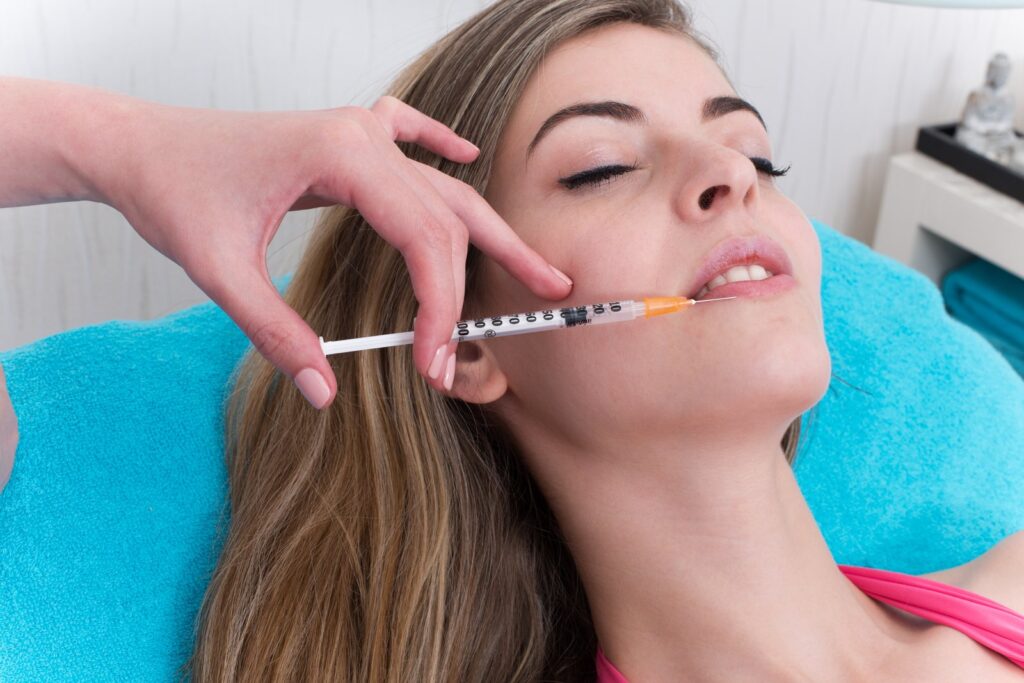
“Botox for bruxism” is a common name for injecting botulinum toxin type A into certain chewing muscles to see whether it reduces clenching or grinding.
Botulinum toxin temporarily blocks the signal between nerve and muscle, so the treated muscle contracts with less force.
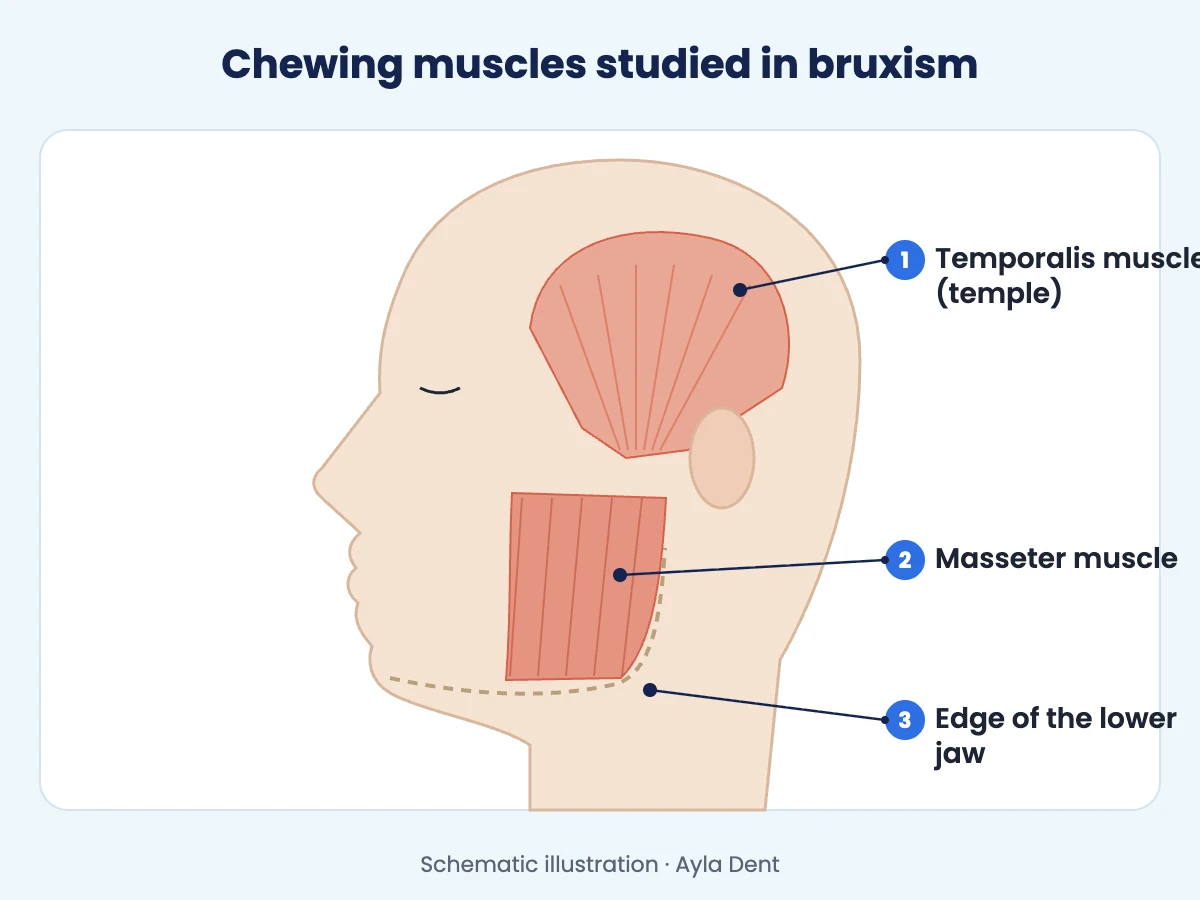
Studies on bruxism mainly look at the masseter muscle and, in some cases, the temporalis muscle.
A weaker muscle, however, does not mean that everything driving bruxism has been switched off.
What Is the Masseter Muscle?
The masseter is one of the main chewing muscles. It runs along each side of the jaw and is especially active when you clench.
It is essential for chewing, so any treatment that changes how it works has to weigh possible benefits against possible risks.
Does Botox Treat Bruxism?
Botulinum toxin for bruxism has been examined in several clinical studies.
A 2025 overview in the journal Toxins pulled together the existing systematic reviews. Some studies reported lower pain, fewer bruxism events and reduced maximum bite force. The authors also found that the reviews were of low methodological quality, so no firm conclusion could be drawn, and they called for better-designed studies.
Studies also differ widely in their methods, injection protocols and the outcomes they measure.
Current evidence does not show that botulinum toxin permanently stops bruxism or works for every patient.
A measurable drop in muscle activity also does not automatically mean the same level of relief from pain or day-to-day symptoms.
Botox vs Night Guard: Are They the Same?
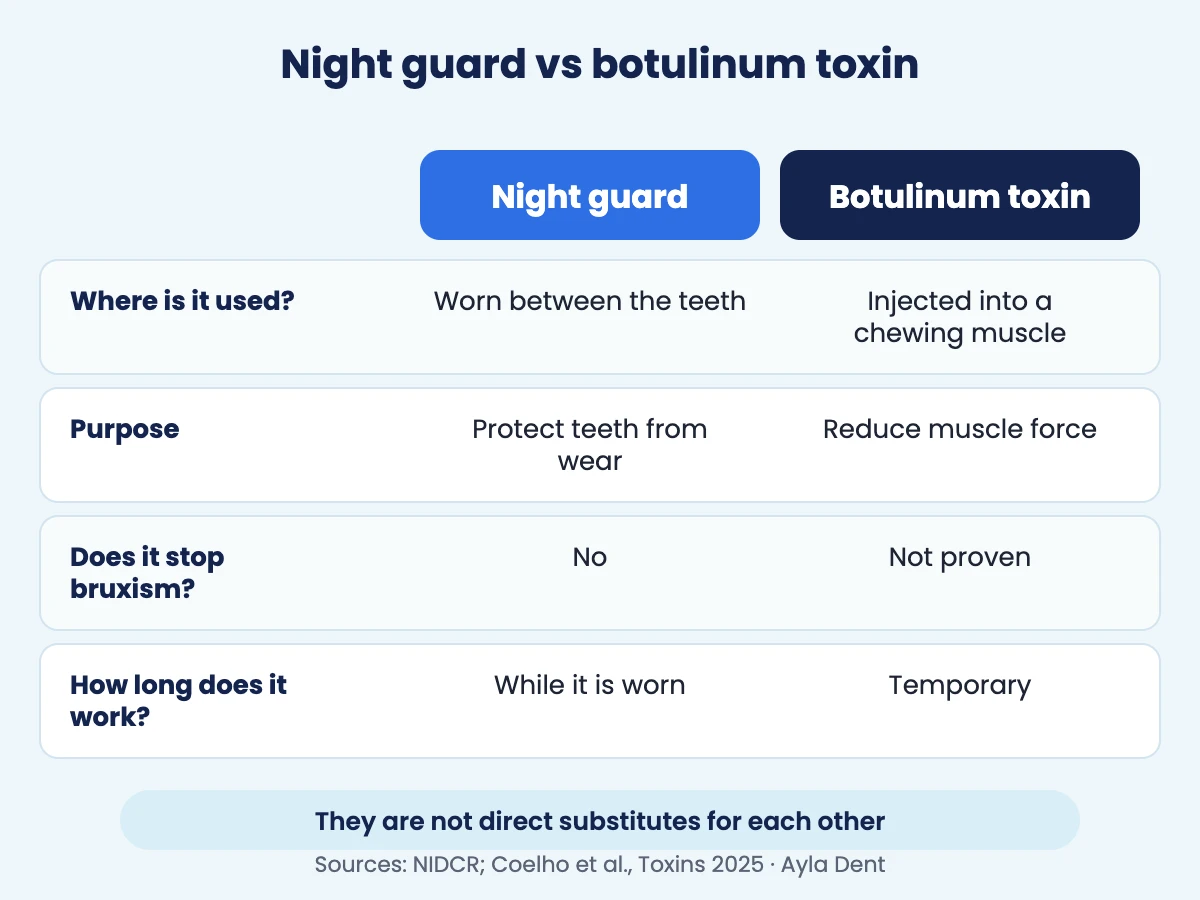
No. They have different goals and work in different ways.
A night guard is an appliance worn in the mouth that keeps the teeth apart to limit mechanical damage.
Botulinum toxin acts on the muscle and can reduce how much force it produces.
They are not direct substitutes for each other. The right approach depends on your symptoms, what the dentist finds in your mouth and the evidence behind each option.
Related reading: Night Guard for Teeth Grinding: What It Does and How to Use It
What Are the Possible Risks?
Botulinum toxin injections into the chewing muscles can cause:
- Pain or bruising at the injection site
- Reduced chewing strength
- Temporary muscle weakness
- Changes in facial appearance or smile symmetry
- Other unwanted effects related to the injection
The long-term effects of repeated injections on muscle volume and the jawbone are still being studied, and not all questions have been answered.
Safety also depends on your health, the product used and the conditions under which it is given.
What Else Can Help With Bruxism?
Managing bruxism starts with your symptoms, any damage to the teeth and related conditions.
Depending on the dental assessment, options can include a custom protective appliance, becoming more aware of daytime clenching, better sleep habits and stress management.
If there are signs of sleep apnoea or another sleep disorder, a medical sleep assessment is important.
Related reading: What Is Bruxism? Teeth Grinding Causes and Treatment
Does Botox Help TMJ Pain?
Pain around the jaw joint can have different causes. Muscle pain and structural problems inside the joint are not the same thing.
NIDCR states that research on botulinum toxin for temporomandibular disorders has produced mixed results and that it remains unclear whether it relieves TMD symptoms.
Having jaw pain, then, does not mean botulinum toxin is an appropriate option.
Frequently Asked Questions
Is Botox for teeth grinding permanent?
No. The effect of botulinum toxin on the muscle is temporary, and it cannot be said to cure bruxism.
Does masseter Botox stop teeth grinding completely?
There is no reliable, general answer. Some studies show reduced muscle activity, but it has not been shown that bruxism stops completely.
Can Botox replace a night guard?
Botulinum toxin and a night guard do different jobs. One cannot simply be swapped for the other.
Does everyone who grinds their teeth need Botox?
No. Mild bruxism often needs no treatment at all. Any invasive treatment should be judged on clinical need, scientific evidence, safety and the regulations that apply.
Conclusion
Researchers are studying how botulinum toxin affects the muscle activity linked to bruxism. Current evidence is not strong enough to call it a standard or permanent solution for everyone.
The priority in managing bruxism is assessing any damage to the teeth, identifying related symptoms and using suitable protective measures.
This article explains current scientific findings. It is not intended to recommend or promote botulinum toxin treatment. Eligibility, indications and local regulations must be assessed separately.
Grinding can shorten the life of crowns and veneers. See dental veneers and zirconia crowns for more.
Sources
- Coelho MS et al. Botulinum Toxin for Bruxism: An Overview. Toxins, 2025;17(5):249: https://www.mdpi.com/2072-6651/17/5/249
- NIDCR – Temporomandibular Disorders (TMDs): https://www.nidcr.nih.gov/health-info/tmd
- NIDCR – Bruxism: https://www.nidcr.nih.gov/health-info/bruxism