
For people who have lost all their teeth in one jaw, or whose remaining teeth cannot be saved, one option is a fixed set of teeth held by a small number of implants. The best-known version of this approach is All-on-4.
All-on-4 replaces a full arch of teeth with a fixed bridge attached to four implants. It does not suit everyone. Bone, general health and expectations are assessed after an examination and a 3D scan.
For an overview of implant treatment, see our dental implants page.

What Is All-on-4?
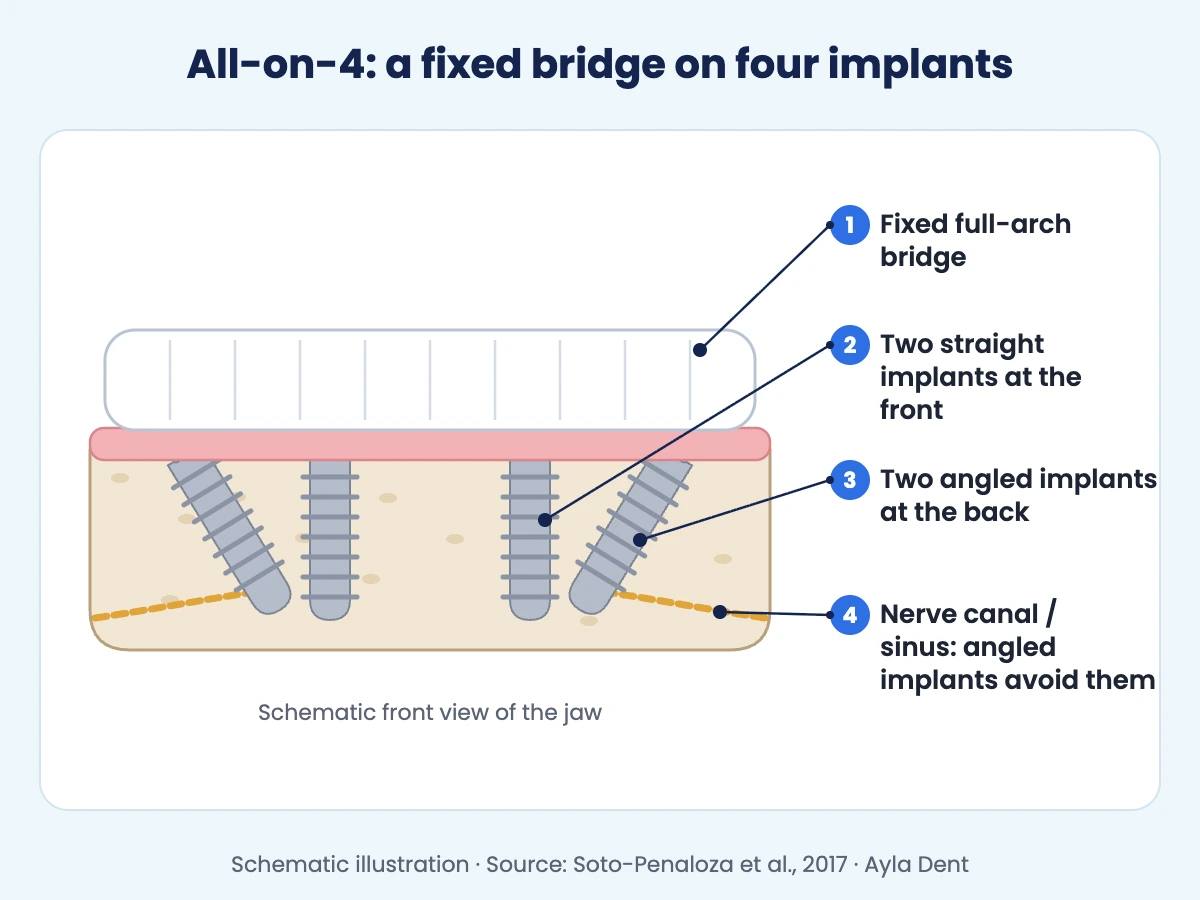
All-on-4 is a treatment concept in which four implants are placed in a jaw with no teeth, and a fixed full-arch bridge is attached to them.
Two implants go straight into the front of the jaw. The two at the back are placed at an angle.
Angling the back implants helps them avoid structures such as the sinus in the upper jaw and the nerve canal in the lower jaw. In some patients, this means implants can be placed without bone grafting.
Who Is All-on-4 For?
All-on-4 may be considered if:
- All the teeth in one jaw are missing
- The remaining teeth cannot be saved because of advanced gum disease or fractures
- You are unhappy with a removable denture
- There is enough bone in the front of the jaw for implants
Poorly controlled diabetes, heavy smoking and some medicines can affect the plan, so share your full medical history.
If bone loss is very advanced, other options may be needed. In the upper jaw, one of these is zygomatic implants. For bone grafting options, see: Dental Implant Without Enough Bone
How Is All-on-4 Done?
Examination and Planning
A clinical exam and a 3D CT scan show the amount of bone and the position of the sinus and nerve canal. The position and angle of each implant are planned from this.
Placing the Implants
Teeth that cannot be saved can be removed and the implants placed at the same appointment. The procedure is done under local anaesthetic, and sedation may also be an option.
Temporary Fixed Teeth
In suitable patients, if the implants are stable enough at placement, a temporary fixed bridge can be fitted shortly afterwards. This is what is often called “teeth in a day”.
This decision is made during surgery. If stability is not sufficient, the implants may need time to heal first.
Final Bridge
Once the implants have fused with the bone, the final bridge is made. This healing period usually takes a few months, depending on your bone and how you heal.

All-on-4 or Dentures?
| Feature | All-on-4 | Complete denture |
|---|---|---|
| Stability | Fixed to implants | Removable |
| Surgery | Required | Not required |
| Palate | Upper bridge usually leaves the palate uncovered | Upper denture covers the palate |
| Cleaning | In the mouth, with special tools | Taken out to clean |
| Check-ups | Regular professional check-ups | Regular checks for fit |
The right choice depends on your bone, general health and expectations.
All-on-4 vs All-on-6
The difference is the number of implants supporting the bridge. Depending on bone volume, jaw shape and bite forces, five or six implants may be planned instead of four.
More implants do not automatically mean a better result. The right number comes from individual planning.
For a detailed comparison and the research data, see All-on-6 Dental Implants
Caring for All-on-4
Because the bridge stays in, cleaning under it and around the implants matters.
- Use interdental brushes or a water flosser alongside your toothbrush.
- At check-ups, the bridge and implants are examined. When needed, the dentist removes the bridge to clean it.
- If you grind or clench your teeth, a night guard may be recommended to protect the bridge.
Poor cleaning can lead to inflammation around the implants: Peri-Implantitis: Signs and Treatment
For the first days of recovery, see: After a Dental Implant: Pain, Swelling and Diet
Frequently Asked Questions
How long does All-on-4 take?
In suitable patients, the implants and temporary fixed teeth can be completed within a short time. The final bridge follows a healing period of a few months.
Does All-on-4 hurt?
The procedure is done under anaesthetic. Pain, swelling and tenderness are common in the first days afterwards and ease over time.
Can I take the All-on-4 bridge out?
No, you cannot. It can be designed so that your dentist can remove it when needed.
How long does All-on-4 last?
There is no single figure. Oral hygiene, regular check-ups, teeth grinding and general health all affect long-term results. The bridge may need maintenance or replacement over time.
Can All-on-4 be done on both jaws?
Yes. Upper and lower jaws can be treated separately or together, each with its own plan.
Conclusion
All-on-4 is a treatment concept that gives suitable patients with no teeth in a jaw a fixed bridge on four implants. Suitability depends on your bone, general health and expectations.
This article is for general information only. Suitability for treatment is decided after an examination and the necessary imaging.
Sources
- Soto-Penaloza D. et al. – The all-on-four treatment concept: Systematic review. J Clin Exp Dent, 2017: https://pubmed.ncbi.nlm.nih.gov/28298995/
- Guy’s and St Thomas’ NHS – After having a dental implant: https://www.guysandstthomas.nhs.uk/health-information/dental-implants/after-having-dental-implant