
When every tooth in one jaw is gone, or the teeth that are left can’t be saved, one option is a fixed bridge held by dental implants. Two well-known versions of this idea are All-on-4 and All-on-6.
All-on-6 replaces a full arch of teeth with a single fixed bridge anchored to six implants. It isn’t right for everyone. Bone volume, general health and what you expect from treatment are assessed with an exam and imaging first.
This guide covers what All-on-6 is, who it may suit, how it differs from All-on-4, and what the research actually shows. For an overview of implant treatment, see our Dental Implants page.
What Is All-on-6?
All-on-6 is a full-arch treatment concept: six implants are placed in a jaw with no teeth, and a fixed bridge carrying the whole row of teeth is attached to them.
A single-tooth implant replaces one tooth with one implant and one crown. With All-on-6, the six implants act as anchor points for a bridge that carries far more than six teeth.
It can be used in the upper or lower jaw. All-on-6 is not a brand. It’s a common name for a full-arch fixed bridge planned on six implants.

Who Is All-on-6 For?
All-on-6 may be considered if:
- All the teeth in one jaw are missing
- The remaining teeth can’t be saved because of advanced gum disease, fractures or decay
- You want a fixed alternative to removable dentures
- There’s enough bone for six implants, or enough can be built up with grafting
Having many missing teeth doesn’t automatically mean you need All-on-6. If some natural teeth can be saved, treating them comes first.
Poorly controlled diabetes, heavy smoking, some medications and teeth grinding can all affect the plan. Read more in What Is Bruxism?

How Is All-on-6 Done?
Every plan is tailored to the patient’s mouth and jaw, but treatment usually follows these stages.
1. Exam and Planning
The teeth, gums and jawbone are examined. A panoramic X-ray and a 3D CBCT scan are used when needed. The plan maps the available bone, structures such as the sinus and the nerve canal, your bite and the design of the final bridge.
2. Preparatory Treatment
Teeth that can’t be saved may be extracted. Gum disease, infection or bone loss may need treating first. Not everyone needs extractions or a bone graft.
3. Placing the Implants
Six implants are placed in the planned positions. The number matters less than the layout. The position, angle and spread of the implants along the jaw decide how well they carry the bridge.
4. Temporary Bridge
When conditions allow, a temporary fixed bridge can be fitted the same day or soon after surgery. This is called immediate loading. It depends on the implants being firmly stable from the start and on good bone quality, so it isn’t suitable for everyone.
5. Healing
The process of bone growing onto the implant surface is called osseointegration. It usually takes a few months and varies with your health, bone and any extra procedures. Our post on What to Expect After a Dental Implant explains the first days.
6. Final Bridge
Once healing is complete, the permanent bridge is made. Its design balances chewing, bite, speech, appearance and how easy it is to clean. Materials and the connection system are chosen for each patient.
All-on-4 vs All-on-6: What’s the Difference?
Both aim to replace a full arch with an implant-supported fixed bridge. The key difference is the number of implants holding it.
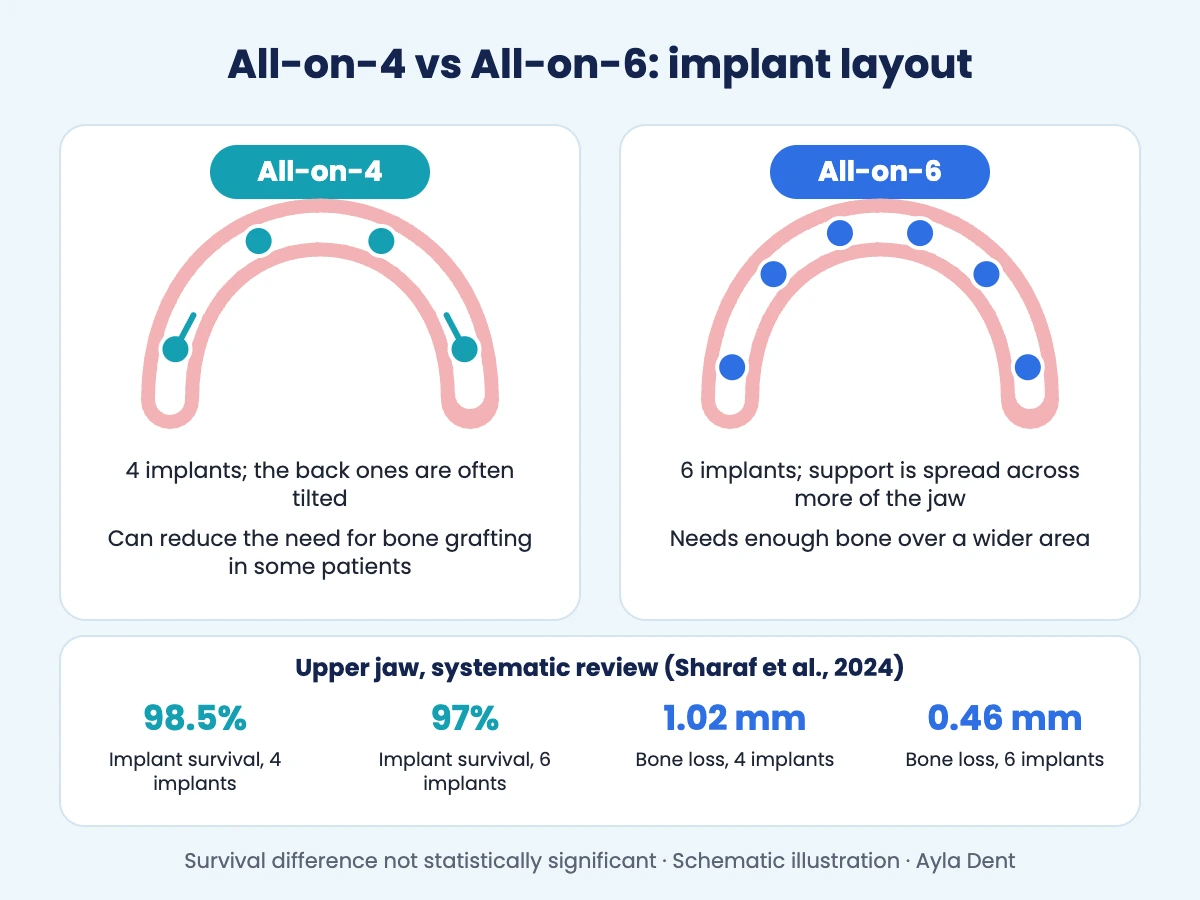
All-on-4 uses four implants. The back implants are often tilted, which can reduce the need for bone grafting in some patients. Learn more in All-on-4 Dental Implants.
All-on-6 uses six implants. It needs enough bone over a wider area of the jaw, and it spreads the support points across more of the arch.
What Does the Research Say?
A 2024 systematic review and meta-analysis (Sharaf et al., Heliyon) compared fixed bridges on four or six implants in the upper jaw:
- Implant survival was 98.5% with four implants and 97% with six. The difference was not statistically significant.
- Bridge survival was above 99% in both groups, with no significant difference.
- Bone loss around the implants was lower with six implants: 0.46 mm on average, against 1.02 mm with four.
- Mechanical and biological complications were slightly more common with four implants, but the difference was not significant.
The authors note that most of the included studies were not randomised trials, and more research is needed.
The International Team for Implantology (ITI) consensus also found no significant difference in implant or bridge survival between full-arch bridges on fewer than five implants and those on five or more.
So six implants are not automatically better than four. The decision rests on your bone, the implant layout, the bridge design and how well the area can be kept clean.
Possible Benefits and Limits of All-on-6
For suitable patients, All-on-6 offers:
- A fixed bridge: it isn’t designed to come out every day like a denture.
- Chewing: a well-designed bridge can help restore chewing function.
- Wider support: six implants can spread the load over more of the jaw.
It also has limits and risks:
- Six implants need enough bone over a wider area, so some patients need grafting.
- Pain, swelling, bleeding or infection can follow surgery.
- An implant may not fuse fully with the bone.
- Inflammation can develop around an implant. See Peri-implantitis.
- Parts of the bridge can loosen, wear or break.
Do You Need Enough Bone for All-on-6?
Yes. Six implants need enough bone along the jaw to sit securely. With advanced bone loss, the areas available for implants may be limited. Options then include bone grafting, a sinus lift, a different implant layout or, in the upper jaw, zygomatic implants. Read more in Dental Implant Without Enough Bone.
Whether your bone is adequate is decided by a clinical exam and a CBCT scan.
How Long Does All-on-6 Take?
The implants are usually placed in one surgery. Bone healing and making the final bridge usually take a few months. Even when a temporary bridge goes in early, healing continues underneath. Extra procedures such as grafting add time.
There’s no single timeline that fits everyone. Yours becomes clear after the exam and planning.
Caring for an All-on-6 Bridge
Having no natural teeth doesn’t stop plaque from building up around implants. Poor cleaning can lead to inflammation and bone loss around them.
The American College of Prosthodontists (ACP) recommends:
- Brush at least twice a day.
- Clean under the bridge and around the implants with floss, an interdental brush and a water flosser.
- See your dental team for professional maintenance every 2 to 6 months, depending on your risk.
- X-ray checks are usually planned every 1 to 2 years.
Which tools suit you depends on your bridge design and how easy you find them to use. Smoking harms healing and the health of the tissue around implants.
If you notice bleeding, swelling, pain or movement around the bridge, don’t wait for your next check-up.

How Long Does All-on-6 Last?
How long an implant bridge lasts depends on the implants, the bridge, your oral hygiene, biting forces, general health and regular check-ups. Implants can work for many years, but results vary from person to person, and parts of the bridge may need maintenance, repair or replacement over time.
What Affects the Scope of Treatment?
The scope of treatment depends on the implant system, any need for grafting, the type of temporary and final bridge, the materials and any additional treatment. That’s why the number of implants alone doesn’t tell you much. The full plan becomes clear after an exam and imaging.
Frequently Asked Questions
How many teeth does All-on-6 replace?
All-on-6 isn’t about replacing six teeth. The six implants carry a bridge for the whole arch. The number of teeth on the bridge depends on your jaw and the bridge design.
Can All-on-6 be done on both jaws?
Yes, in suitable patients. The upper and lower jaws have different bone, so each is planned separately.
Can All-on-6 be done in one day?
In some patients, the implants and a temporary bridge can be fitted the same day. The permanent bridge is made after healing.
All-on-6 or All-on-4?
The number of implants alone isn’t enough to decide. Research has found no significant difference in survival between the two. Bone, bridge design and load distribution are weighed together.
Can an All-on-6 bridge be removed?
It isn’t designed for you to remove daily. Depending on the connection, your dentist can take it off when needed.
Is there an age limit?
Age alone doesn’t decide it. Jaw growth must be complete, and general health and bone are assessed together.
Does teeth grinding affect All-on-6?
Grinding and clenching increase the forces on the bridge and can raise the risk of mechanical problems. It’s taken into account in planning, and a night guard may be recommended.
Summary
All-on-6 is one way to replace all the teeth in a jaw with a fixed bridge on six implants. Not every toothless jaw needs six implants. For some people, a bridge on four implants or another option may suit better.
The decision depends on the remaining teeth, the jawbone, general health and long-term care.
This article is for general information. It does not replace an examination.
Sources
- Sharaf MA et al. Outcomes that may affect implant and prosthesis survival and complications in maxillary fixed prosthesis supported by four or six implants: a systematic review and meta-analysis. Heliyon. 2024;10(3):e24365. https://pmc.ncbi.nlm.nih.gov/articles/PMC10839890/
- ITI Consensus Database. Number of Implants Placed for Complete-Arch Fixed Prostheses. https://academy.iti.org/my-academy/-/my/consensus-db/1701
- American College of Prosthodontists. Position Statement: Maintenance of Full-Arch Implant Restorations (2023). https://www.prosthodontics.org/about-acp/position-statement-maintenance-of-full-arch-implant-restorations/
- First Global Consensus for Clinical Guidelines for the Rehabilitation of the Edentulous Maxilla. https://www.ncbi.nlm.nih.gov/pmc/articles/PMC12930121/