
Mouthwash is a liquid you rinse your mouth with. There are many kinds on the shelf, and they are not all meant for the same job.
Mouthwash does not replace brushing or cleaning between your teeth. With the right ingredients, at the right time, it can support that routine.
For the bigger picture of daily oral care, see: Daily Oral Care Guide
Types of Mouthwash
| Type | Purpose | Points to note |
|---|---|---|
| Fluoride | Helps prevent tooth decay | Do not use straight after brushing |
| Chlorhexidine | Short-term control of plaque and gum inflammation | Use for a limited time, on a dentist’s advice |
| Alcohol-based | Fresh feeling | Can sting and dry the mouth |
| Alcohol-free | Fresh feeling, sensitive mouths | Purpose depends on ingredients |
Fluoride Mouthwash
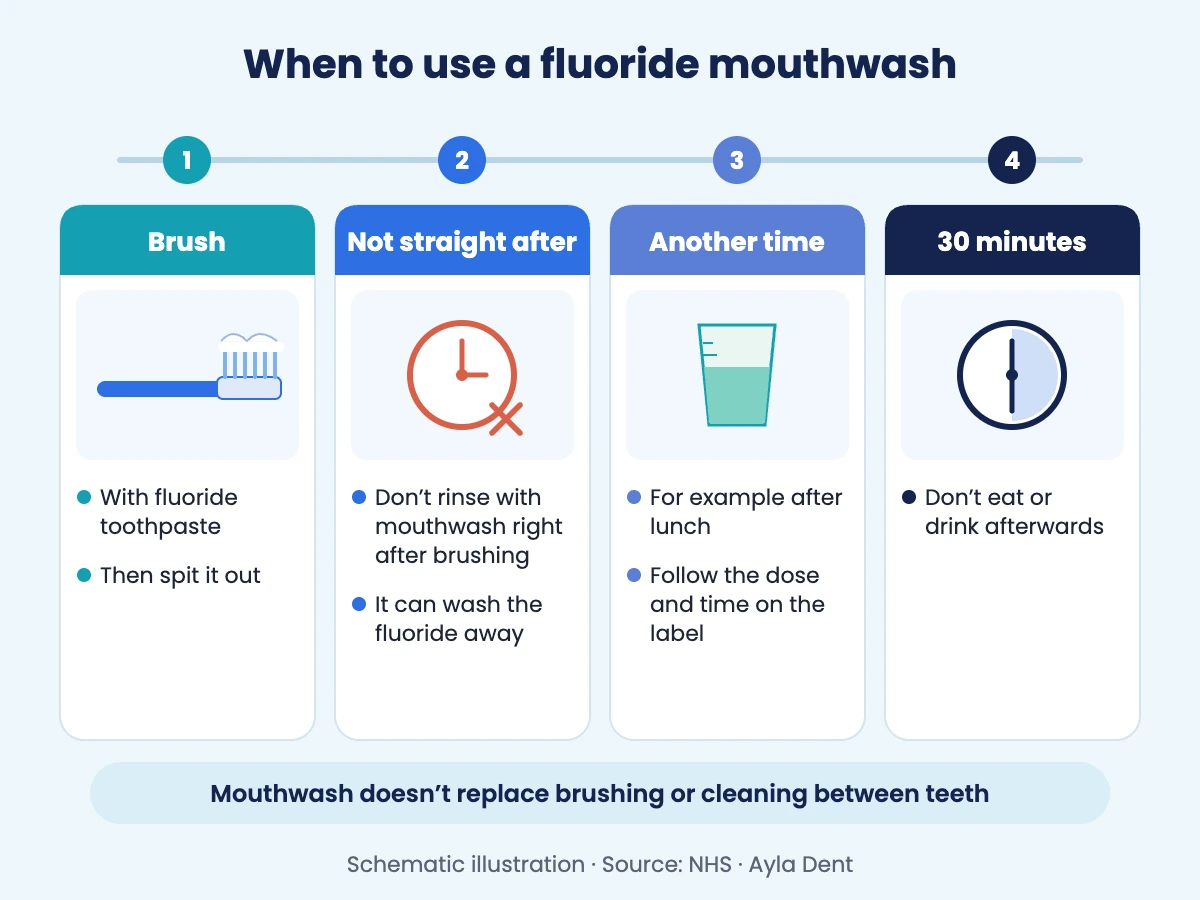
Fluoride mouthwash can help prevent tooth decay. The NHS advises against using it straight after brushing, because it can wash away the concentrated fluoride left on your teeth by toothpaste.
Use it at a different time, such as after lunch. After a fluoride mouthwash, avoid eating or drinking for 30 minutes.
Chlorhexidine Mouthwash
Chlorhexidine is an antiseptic used for short-term control of plaque and gum inflammation, usually after gum treatment or oral surgery and on a dentist’s advice.
A Cochrane review found that, used alongside brushing, chlorhexidine mouthwash can reduce plaque and gum bleeding in people with mild gum inflammation. The same review reported tooth staining and more tartar build-up with longer use.
So it is not recommended for routine, ongoing use. Your dentist will tell you how long to use it.
Can You Use Mouthwash Every Day?
It depends on the type and the reason you are using it.
- Fluoride mouthwash can be used daily if your dentist recommends it.
- Chlorhexidine mouthwash should be used only for as long as your dentist advises.
- Cosmetic mouthwashes freshen your breath briefly but do not remove the cause of bad breath.
If bad breath persists, the cause should be investigated: Bad Breath: Causes and Solutions
Possible Side Effects
- Staining of the teeth and tongue (especially chlorhexidine)
- Temporary change in taste
- Stinging or dryness (especially alcohol-based products)
- Irritation in sensitive mouths
If you notice side effects, stop using it and ask your dentist.
How to Use Mouthwash
- Measure the amount on the label.
- Rinse for the time stated.
- Spit it out. Do not swallow.
- If the label says so, avoid eating or drinking for a while.
Young children may swallow mouthwash, so ask your dentist before giving it to a child.
Frequently Asked Questions
Can mouthwash replace brushing?
No. It only supports brushing and cleaning between the teeth. It does not mechanically remove sticky plaque.
Does mouthwash stop bleeding gums?
Some mouthwashes can help in the short term. The cause is usually plaque and tartar, and that needs treating: Bleeding Gums: Causes and What to Do
Is alcohol-based mouthwash harmful?
It can cause stinging and dryness for some people. If you have a sensitive mouth, ask your dentist about alcohol-free options.
Can I use mouthwash after an implant?
After implant surgery, your dentist may recommend a specific mouthwash for a set period. Follow those instructions: After a Dental Implant: Pain, Swelling and Diet
Conclusion
Different mouthwashes have different purposes. Fluoride mouthwash can help prevent decay, and chlorhexidine can help control gum inflammation in the short term. None of them replaces brushing and cleaning between your teeth. Your dentist can suggest the right product and how long to use it.
This article is for general information only and does not replace personal diagnosis or treatment advice.
Sources
- NHS – How to keep your teeth clean: https://www.nhs.uk/live-well/healthy-teeth-and-gums/how-to-keep-your-teeth-clean/
- James P et al. – Chlorhexidine mouthrinse as an adjunctive treatment for gingival health. Cochrane Database of Systematic Reviews, 2017 (NIHR Evidence summary): https://evidence.nihr.ac.uk/alert/chlorhexidine-mouthwash-is-useful-short-term-for-people-with-mild-gum-disease/