
A veneer is a thin shell of porcelain or composite bonded to the front of a tooth. It can change a tooth’s colour, shape or length while keeping as much of the natural tooth as possible.
A veneer covers only the visible front surface of a tooth, not the whole tooth. That’s why it usually needs less tooth removal than a crown. But veneers aren’t right for every tooth or every mouth.
This guide covers the types of veneers, who they suit, what long-term research shows and what affects how long they last. For restorations that cover the whole tooth, see What Is a Dental Crown? and Zirconia Crowns.
What Are Veneers?
A veneer is a thin shell, often less than a millimetre thick, bonded to the front of a tooth with an adhesive system.
The key difference from a crown is coverage. A crown wraps around the whole tooth. A veneer works on the front surface and, when needed, the biting edge. That makes it one of the first options considered for cosmetic changes to healthy front teeth.
Porcelain vs Composite Veneers
Veneers are made from two main materials.
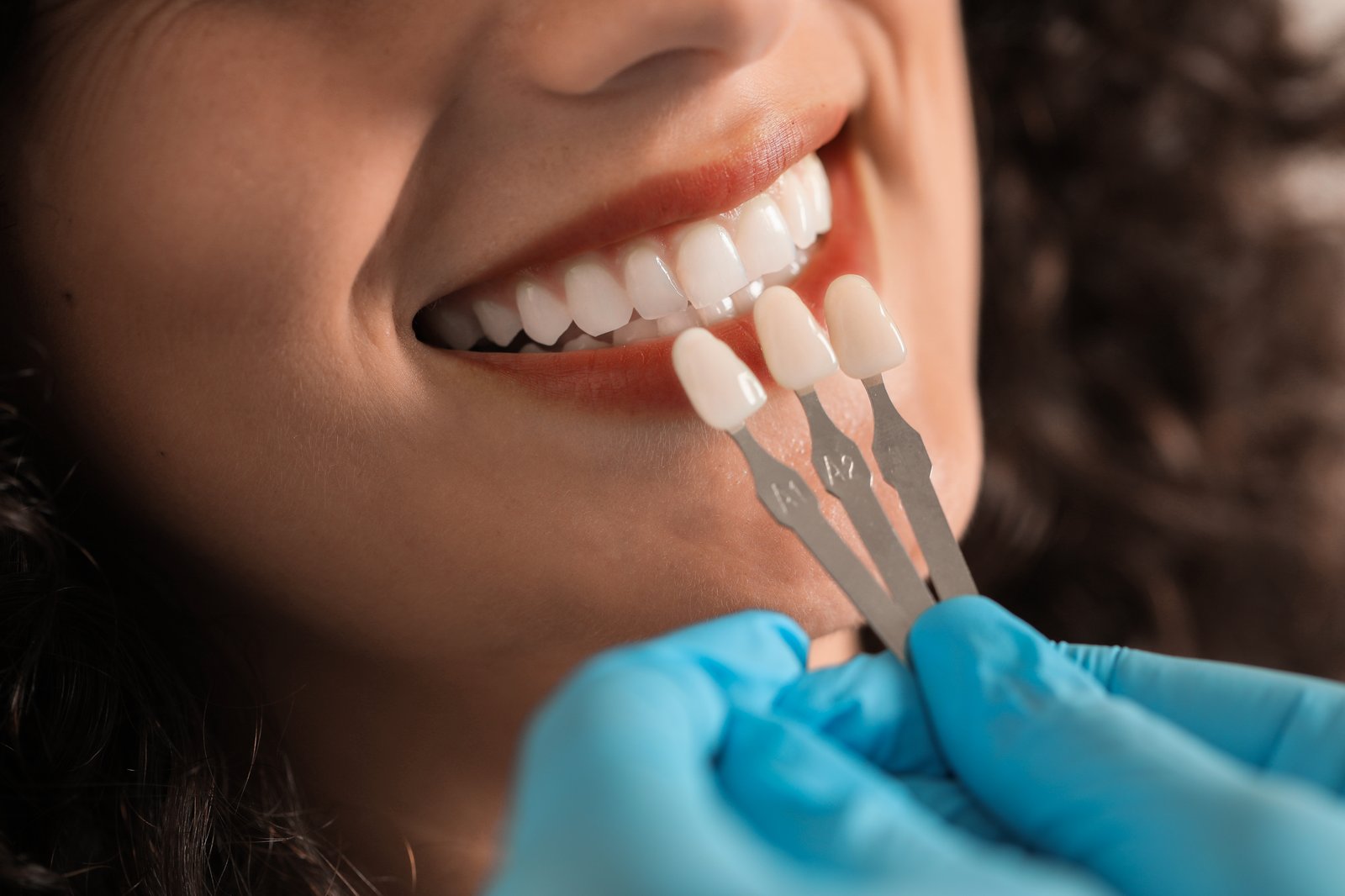
- Porcelain (ceramic) veneers are made in a dental lab and then bonded to the tooth. They resist staining and keep a smooth surface. Feldspathic porcelain and glass-ceramics such as lithium disilicate are common choices.
- Composite veneers are made from tooth-coloured resin. They’re usually sculpted directly on the tooth by the dentist, though they can also be made in a lab. They need less tooth removal and are easy to repair, but they can stain and wear over time.
Learn more in Composite Bonding.
When Are Veneers Considered?
Veneers may be an option for:
- Discolouration that whitening can’t fix
- Small gaps between front teeth
- Chipped, worn or short-looking front teeth
- Small or unusually shaped teeth
- Mild crowding, when orthodontic treatment isn’t suitable or wanted
If the problem is surface staining, whitening may come first. If teeth are clearly crooked, orthodontics may achieve the result with less intervention.

When Veneers May Not Be Suitable
Veneers need careful planning, or may not be recommended, if:
- There’s untreated decay or gum disease
- Too little enamel is left for reliable bonding
- Clenching or grinding isn’t under control
- Your bite puts heavy force on the front teeth (for example, an edge-to-edge bite)
- Oral hygiene is poor
These are checked at the exam. Gum treatment, fillings or a night guard may be planned first.
What Does Long-Term Research Show?
The strongest evidence on porcelain veneers comes from systematic reviews that pool long-term clinical studies.
A meta-analysis of 13 clinical studies found an estimated survival rate of 89% over a median follow-up of 9 years. Survival was 94% for glass-ceramic and 87% for feldspathic porcelain veneers, and the type of ceramic didn’t significantly affect failure (Morimoto et al., 2016).
A review of 25 studies estimated 95.5% cumulative survival at 10 years, with most failures happening in the first years after bonding (Alenezi et al., 2021).
The evidence on composite veneers is more limited. A meta-analysis of randomised trials, with follow-up of 2 to 8 years, found an overall survival of 88%. Direct composite veneers did better than lab-made ones (Lim et al., 2023).
Why Enamel Matters
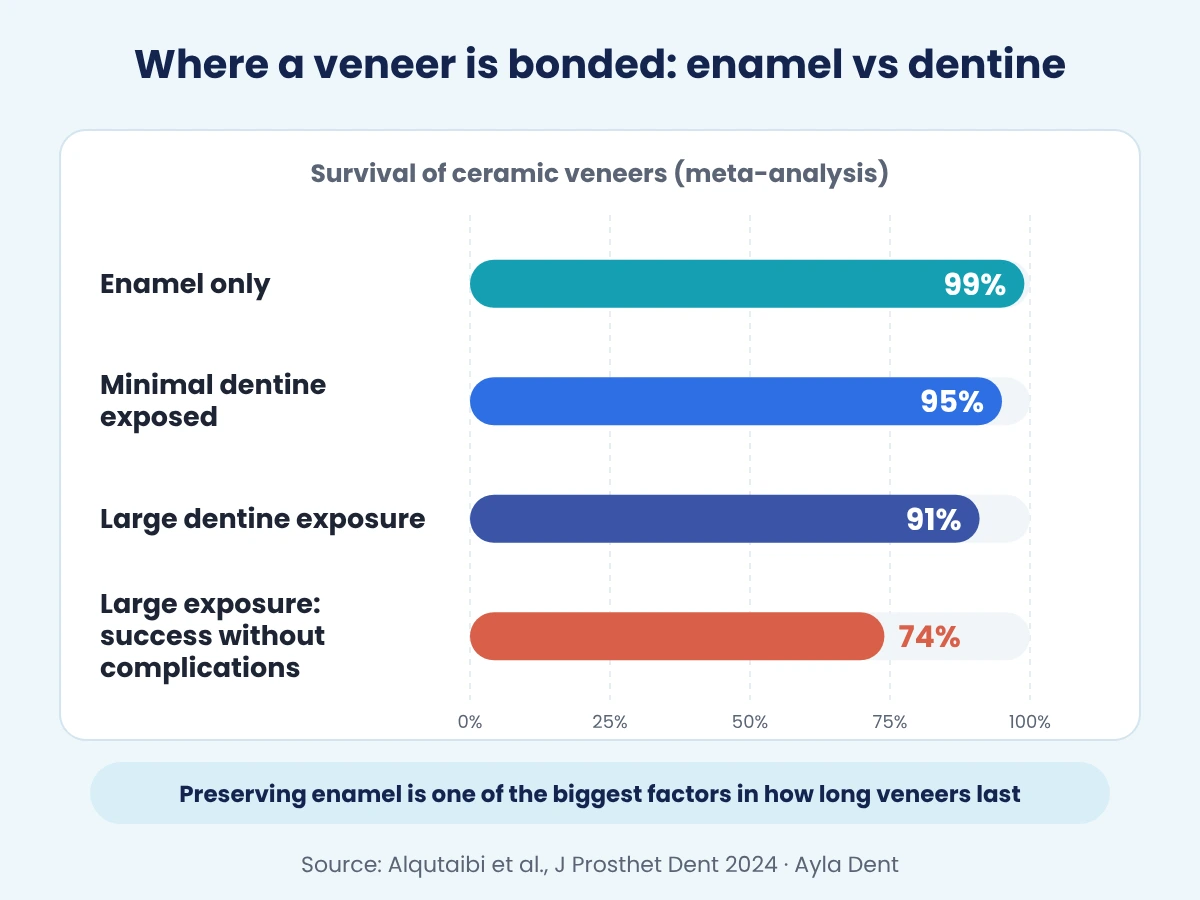
How well a veneer lasts depends heavily on what it’s bonded to. Adhesives bond far more strongly to enamel, the hard outer layer of the tooth, than to the dentine beneath it.
A meta-analysis of clinical studies found:
- Veneers bonded only to enamel: 99% survival
- Minimal dentine exposed: 95% survival
- Large areas of dentine exposed: 91% survival, and only 74% without complications (Alqutaibi et al., 2024)
So a good veneer plan sets out in advance how much tooth will be removed. The goal is to keep as much enamel as possible.
Can Veneers Be Done Without Drilling?
Sometimes veneers can be placed with little or no preparation. This usually works for small teeth, teeth that sit slightly back, or teeth with gaps between them.
It doesn’t suit everyone. Adding a veneer to a tooth that already sits forward or is already large can make it look bulky and make the gumline harder to clean. Whether preparation is needed depends on the tooth’s position and the result you’re aiming for.
Teeth Grinding and Veneers
Clenching and grinding (bruxism) increase the force on veneers and raise the risk of fracture and debonding.
In an 8-year prospective study, patients who ground their teeth and wore a night guard had 89.1% veneer survival at 7 years. In those who didn’t wear one, survival fell to 63.9% (Faus-Matoses et al., 2020).
Grinding doesn’t always rule out veneers, but it shapes the plan, and a night guard is usually recommended afterwards. See What Is Bruxism? and Night Guard for Teeth Grinding.
Common Problems
According to pooled data, the most frequent problems with porcelain veneers are (Morimoto et al., 2016):
- Fracture or chipping: 4%
- Debonding: 2%
- Marked staining at the edge: 2%
- Need for root canal treatment: 2%
- Decay at the edge: 1%
Small chips and edge staining can often be polished or repaired. A veneer that comes off intact can often be bonded again.

The Veneer Process
- Exam and planning: teeth, gums, bite and smile line are assessed, with X-rays if needed.
- Design and preview: a digital smile design or a temporary mock-up lets you see the result in your mouth first.
- Preparation: if needed, a thin layer is removed from the front of the tooth, keeping enamel wherever possible.
- Impression or scan: an impression or intraoral scan is taken.
- Bonding: fit, colour and bite are checked before the veneers are bonded.
Composite veneers involve fewer steps and are often finished in a single visit.
How Long Do Veneers Last?
It depends on the material, how much enamel is left, your bite, any grinding habit and your oral hygiene. Long-term survival of porcelain veneers is high in research, but individual results vary. Composite veneers may need polishing or replacing over time.
Habits that help veneers last:
- Brushing twice a day with fluoride toothpaste
- Cleaning veneer edges with floss or an interdental brush
- Not biting nails, pens or hard shells with your front teeth
- Wearing a night guard if you grind
- Regular dental check-ups
Frequently Asked Questions
Veneers or crowns?
Veneers cover only the front of the tooth and need less tooth removal. Crowns cover the whole tooth. Veneers are usually considered for cosmetic changes to healthy front teeth, while crowns may suit teeth with large fillings, fractures or root canal treatment.
Can teeth with veneers decay?
Porcelain can’t decay, but the natural tooth underneath can, especially where the veneer meets the tooth. Keeping that edge clean matters.
Are veneers reversible?
Veneers are a permanent treatment. If tooth structure was removed, the tooth will need a new restoration if the veneer is ever taken off.
Do veneers stain?
Porcelain veneers don’t change colour noticeably over time. Composite veneers can pick up stains from coffee, tea and smoking. Whitening doesn’t change a veneer’s colour, so if you’re considering it, do it before treatment.
Can I get just one veneer?
Yes. Matching one veneer to the neighbouring teeth takes more careful work, but it’s possible.
Summary
A veneer is a thin restoration bonded to the front of a tooth to improve its colour, shape or length. Research shows high long-term survival for porcelain veneers. The factors that matter most are preserving enamel, controlling grinding and good oral hygiene.
The right material and the amount of preparation are decided after an exam and smile planning.
This article is for general information. It does not replace an examination.
Sources
- Morimoto S, Albanesi RB, Sesma N, Agra CM, Braga MM. Main Clinical Outcomes of Feldspathic Porcelain and Glass-Ceramic Laminate Veneers: A Systematic Review and Meta-Analysis of Survival and Complication Rates. Int J Prosthodont. 2016;29(1):38–49. https://pubmed.ncbi.nlm.nih.gov/26757327/
- Alenezi A, Alsweed M, Alsidrani S, Chrcanovic BR. Long-Term Survival and Complication Rates of Porcelain Laminate Veneers in Clinical Studies: A Systematic Review. J Clin Med. 2021;10(5):1074. https://doi.org/10.3390/jcm10051074
- Lim TW, Tan SK, Li KY, Burrow MF. Survival and Complication Rates of Resin Composite Laminate Veneers: A Systematic Review and Meta-Analysis. J Evid Based Dent Pract. 2023;23(4):101911. https://doi.org/10.1016/j.jebdp.2023.101911
- Alqutaibi AY, Saker S, Alghauli MA, Algabri RS, AbdElaziz MH. Clinical survival and complication rate of ceramic veneers bonded to different substrates: A systematic review and meta-analysis. J Prosthet Dent. 2024. https://doi.org/10.1016/j.prosdent.2024.03.019
- Faus-Matoses V, Ruiz-Bell E, Faus-Matoses I, Özcan M, Salvatore S, Faus-Llácer VJ. An 8-year prospective clinical investigation on the survival rate of feldspathic veneers: Influence of occlusal splint in patients with bruxism. J Dent. 2020;99:103352. https://doi.org/10.1016/j.jdent.2020.103352