
A little sensitivity in the first few days after a crown is common. But if pain isn’t easing after a few weeks, is getting worse, or starts years after the crown went on, something is causing it and it should be checked.
There’s no single cause of pain under a crown. A high bite, the tooth’s nerve, decay at the crown edge, gum inflammation or a crack in the tooth can all cause similar symptoms. When the pain started and what triggers it are the most useful clues.
This guide covers the possible causes of crown pain and sensitivity, and when to wait versus when to see your dentist.

Is Sensitivity Normal After a Crown?
Fitting a crown involves removing some tooth and several procedures. So mild sensitivity to hot and cold, or slight discomfort when chewing, can happen in the first days. It usually settles on its own.
In a randomised clinical trial of 496 single crowns, sensitivity after cementation peaked in the first 24 hours, dropped markedly within a week and was minimal by one month. The type of cement used also affected how sensitive teeth were (Alam et al., 2026).
See your dentist if:
- Pain isn’t easing after a few days, or is getting worse
- Pain lingers after the hot or cold has gone
- The tooth throbs on its own, especially at night
- Biting causes a sharp pain
- There’s swelling, a pimple-like bump on the gum or a bad taste
- The crown feels loose or has come off
Possible Causes
1. A High Bite
If the crown meets the opposing tooth before your other teeth do, that tooth takes extra load when you chew. This can cause pain on biting and a feeling that the tooth is “high”. It’s usually fixed with a simple bite adjustment.
2. The Tooth’s Nerve (Pulp)
Preparing the tooth, heat, and any large fillings or decay the tooth had before can all affect the nerve inside. Mild irritation often settles by itself. In some teeth the inflammation becomes irreversible, and root canal treatment may be needed.
A review of complications in fixed prosthodontics found that need for root canal treatment, at 3%, was one of the most common problems with single crowns. For teeth supporting a bridge, the figure was 11% (Goodacre et al., 2003). A meta-analysis of living teeth used to support crowns or bridges found no nerve or root-tip problems in 92–98% of teeth over 5 to 20 years (Kohli et al., 2022).
Nerve-related pain can appear months or even years after a crown. Sometimes the nerve dies without any pain, and the problem only shows up on an X-ray.
3. Decay at the Crown Edge
The crown itself can’t decay, but decay can form where the crown meets the natural tooth. For bridge-supporting teeth, decay is one of the most commonly reported complications (Goodacre et al., 2003). It may cause no symptoms at first, then sensitivity or pain as it progresses.
4. Gum Inflammation
If the crown edge sits very close to the gum or doesn’t fit well, plaque builds up and the gum can become inflamed, with bleeding, redness and tenderness. Edges that are hard to clean can lead to bone loss over time.
5. A Cracked Tooth
If the crowned tooth has a crack, from before or after the crown, biting can cause a brief, sharp pain, often felt as you release the bite. Cracks don’t always show on X-rays.
6. A Loose Crown
When a crown loosens, fluid and bacteria can seep underneath, causing sensitivity and decay. Caught early, a loose crown can often be re-cemented.
7. Clenching and Grinding
Grinding puts extra load on crowned teeth and the tissues around them. Morning jaw tiredness and sensitivity in several teeth point towards it. See What Is Bruxism?
What the Timing Suggests
| When? | Possible causes |
|---|---|
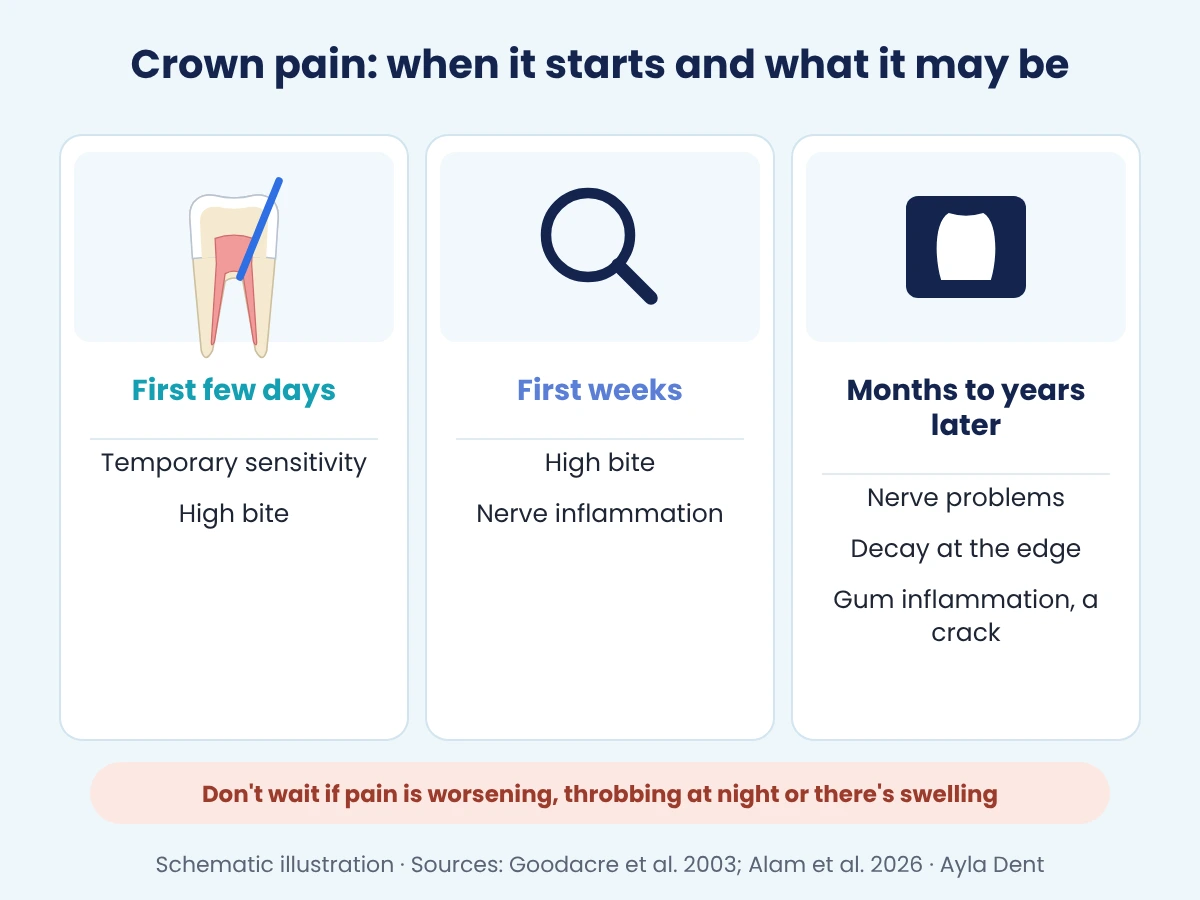
| First few days | Temporary post-treatment sensitivity, high bite |
| First weeks | High bite, nerve inflammation |
| Months to years later | Nerve problems, edge decay, gum inflammation, a crack, loosening |
This is only a rough guide. The actual cause is found at an exam.
What Your Dentist Checks
- When the pain started, what triggers it and how long it lasts
- Your bite
- Hot, cold and biting tests
- The crown edges and gums
- X-rays
Treatment Depends on the Cause
- High bite: the crown surface is adjusted and re-polished.
- Temporary sensitivity: often monitored. Toothpaste for sensitive teeth can help.
- Irreversible nerve inflammation or a dead nerve: root canal treatment may be needed, often through a small opening in the crown. The crown may need replacing afterwards.
- Edge decay: repaired or the crown replaced, depending on size.
- Gum inflammation: professional cleaning and better home care. If the edge fits poorly, replacing the crown may be considered.
- Loose crown: re-cemented if the crown and tooth are sound.
- Crack: assessed according to where it is and how deep it goes.
Prevention
- Brush twice a day with fluoride toothpaste
- Clean crown edges with floss or an interdental brush
- Don’t bite hard objects
- Wear a night guard if you grind
- Keep up regular check-ups and X-rays
Frequently Asked Questions
Why is my crowned tooth sensitive to cold?
Short-term sensitivity after treatment is common. If it lasts, gets worse or lingers after the cold has gone, the nerve may be affected and the tooth should be checked.
Can a tooth decay under a crown?
Yes. The crown can’t decay, but decay can form at the edge where it meets the tooth. Keeping that edge clean and having regular check-ups matters.
Can a crowned tooth have root canal treatment?
Usually, yes. It’s done through an opening in the crown, which is then sealed. In some cases, the crown needs replacing.
Why does my crown hurt when I bite?
The most common cause is a high bite. But nerve inflammation, infection at the root tip or a crack can also cause pain on biting.
Are zirconia crowns less sensitive?
Sensitivity depends more on how the tooth was prepared, its condition beforehand and how well the crown fits than on the material. See Zirconia Crowns.
Summary
Mild sensitivity in the first days after a crown is common and usually passes. If pain lasts, worsens, starts on its own or comes with gum swelling, the cause should be investigated. A high bite, nerve problems, edge decay, gum inflammation and cracks are among the most common causes, and each is treated differently.
This article is for general information. It does not replace an examination.
Sources
- Goodacre CJ, Bernal G, Rungcharassaeng K, Kan JYK. Clinical complications in fixed prosthodontics. J Prosthet Dent. 2003;90(1):31–41. https://pubmed.ncbi.nlm.nih.gov/12869972/
- Alam S, Sadiq N, Elsayed HM, Shakir S, Shaheen NH, Elmarakby AM, Rehman A. Comparison of Post-Cementation Sensitivity Between Resin Modified Glass Ionomer Cement and Conventional Glass Ionomer Cement as a Luting Material: A Randomized Clinical Trial. Clin Exp Dent Res. 2026;12(2):e70339. https://pubmed.ncbi.nlm.nih.gov/41914436/
- Kohli S, Bhatia S, Al-Haddad A, Pulikkotil SJ, Jamayet NB. Pulpal and Periapical Status of the Vital Teeth Used as Abutment for Fixed Prosthesis: A Systematic Review and Meta-Analysis. J Prosthodont. 2022;31(2):102–114. https://pubmed.ncbi.nlm.nih.gov/34516686/