
Almost everyone getting a crown asks the same question: zirconia or porcelain? There’s no single right answer. The right choice depends on where the tooth is, how you bite, whether you grind and what you want it to look like.
In current research, zirconia and porcelain-fused-to-metal crowns have very similar 5-year survival. The real differences are porcelain chipping, whether there’s metal inside, and appearance.
This guide explains what “porcelain crown” usually means, how it differs from zirconia and when each tends to make more sense.
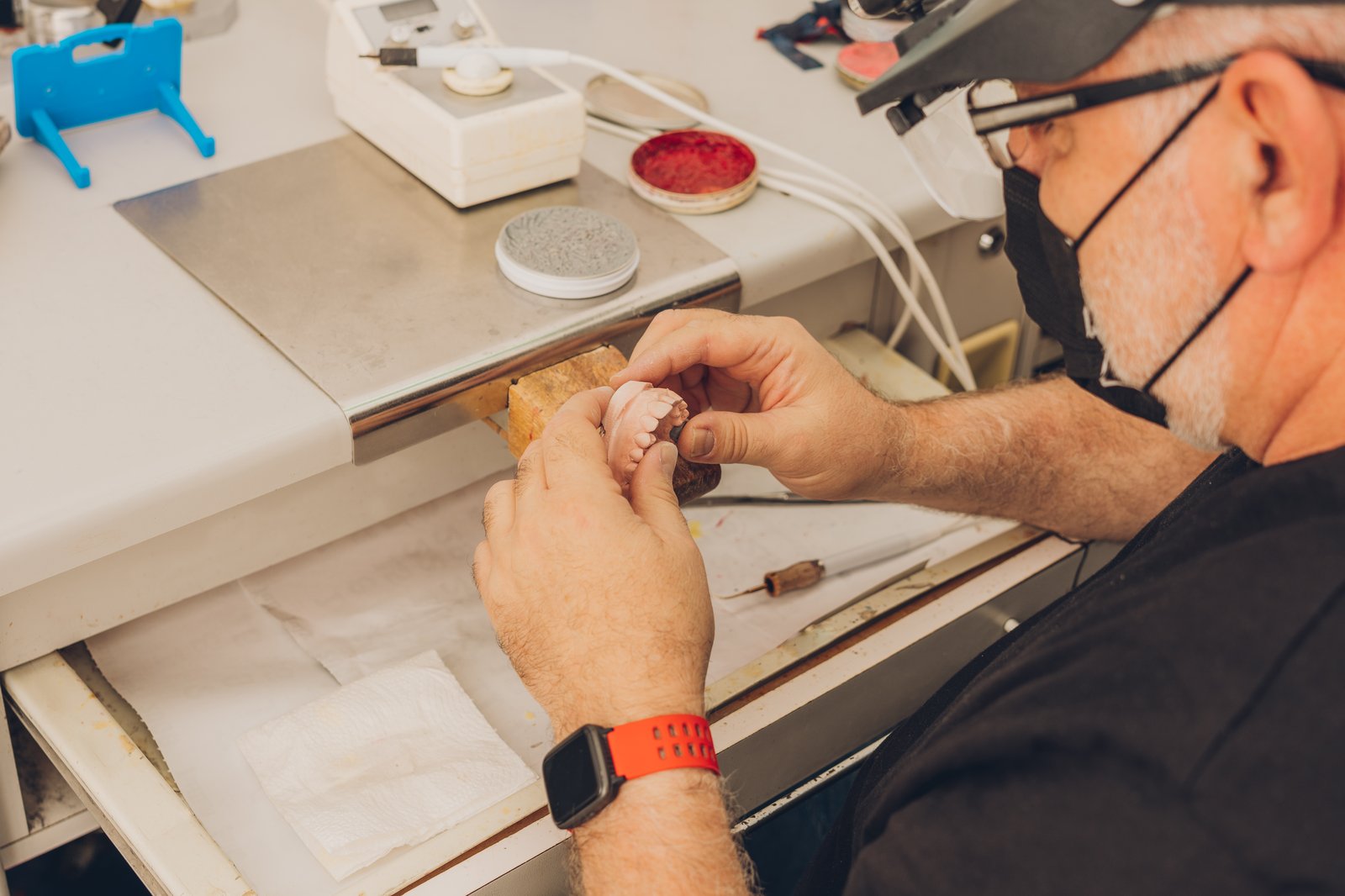
What Does “Porcelain Crown” Mean?
In everyday use, a porcelain crown usually means a porcelain-fused-to-metal (PFM) crown: a metal framework inside with tooth-coloured porcelain on the outside. It’s a long-established, well-understood option.
Today, metal-free ceramic crowns are also common. They fall into two main groups:
- Zirconia: a very strong ceramic, made either as a single solid piece (monolithic) or with porcelain layered on top.
- Glass-ceramics (such as lithium disilicate): let more light through and look very close to natural teeth. Often chosen for front teeth.
So the real question is often: metal-backed porcelain, or metal-free ceramic?
What Does the Research Say?
A large 2026 meta-analysis found these 5-year survival rates for single crowns on natural teeth (Pjetursson et al., 2026):
| Crown type | 5-year survival |
|---|---|
| Porcelain-fused-to-metal | 97.1% |
| Layered zirconia | 97.3% |
| Monolithic zirconia | 96.8% |
| Monolithic lithium disilicate | 98.5% |
Survival is very similar across the board. The clear difference is chipping. Over 5 years, porcelain chipping or fracture was 5.5% for porcelain-fused-to-metal, 7.9% for layered zirconia and just 0.4% for monolithic zirconia, which has no porcelain layer.
A companion meta-analysis on bridges found 5-year survival of 91.3% for porcelain-fused-to-metal, 92.9% for layered zirconia and 87.9% for monolithic zirconia. The authors describe the rates as comparable and note that the monolithic figure is based on only three studies (Romandini et al., 2026).
Key Differences
Appearance
Light can’t pass through metal. With PFM crowns, especially where gums are thin, a grey shadow can show at the gumline. If the gum recedes, the metal edge may become visible.
Metal-free ceramics avoid this. On front teeth, more translucent ceramics give a more natural look. Monolithic zirconia can be made more opaque for strength.
Strength and Chipping
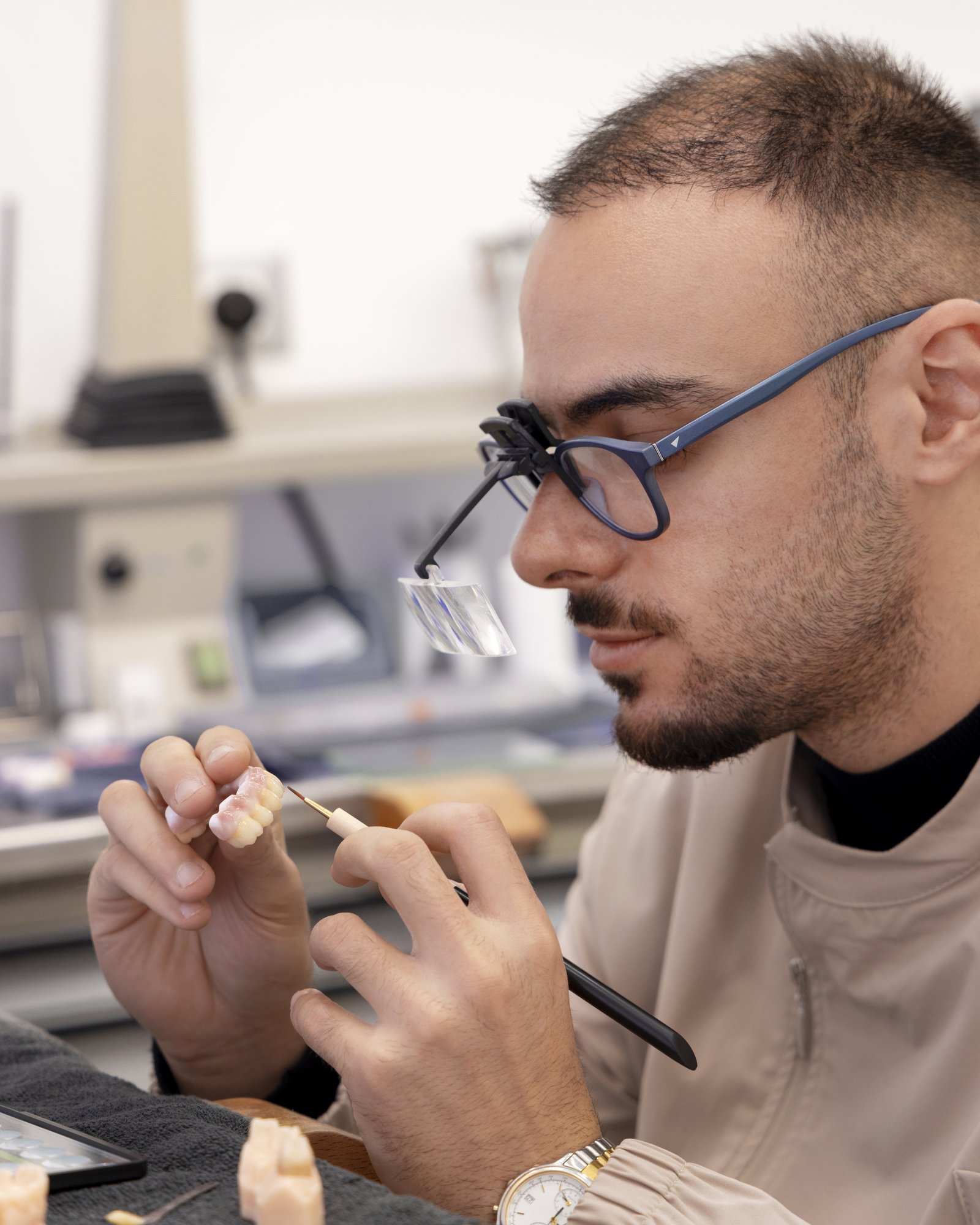
With PFM and layered zirconia, the most common problem is the top porcelain layer chipping. Monolithic zirconia has no such layer, so chipping is much rarer. That’s why it’s often chosen for back teeth and for people who grind.
Metal Content
Rarely, people react to certain metal alloys. For anyone with a metal sensitivity, or who simply prefers a metal-free restoration, zirconia and glass-ceramics are options.

Tooth Removal
Whatever the material, a full crown means removing a significant amount of tooth. Monolithic ceramics can sometimes be made thinner, which may allow slightly less removal, but that depends on the tooth and the material.
Which Suits Which Situation?
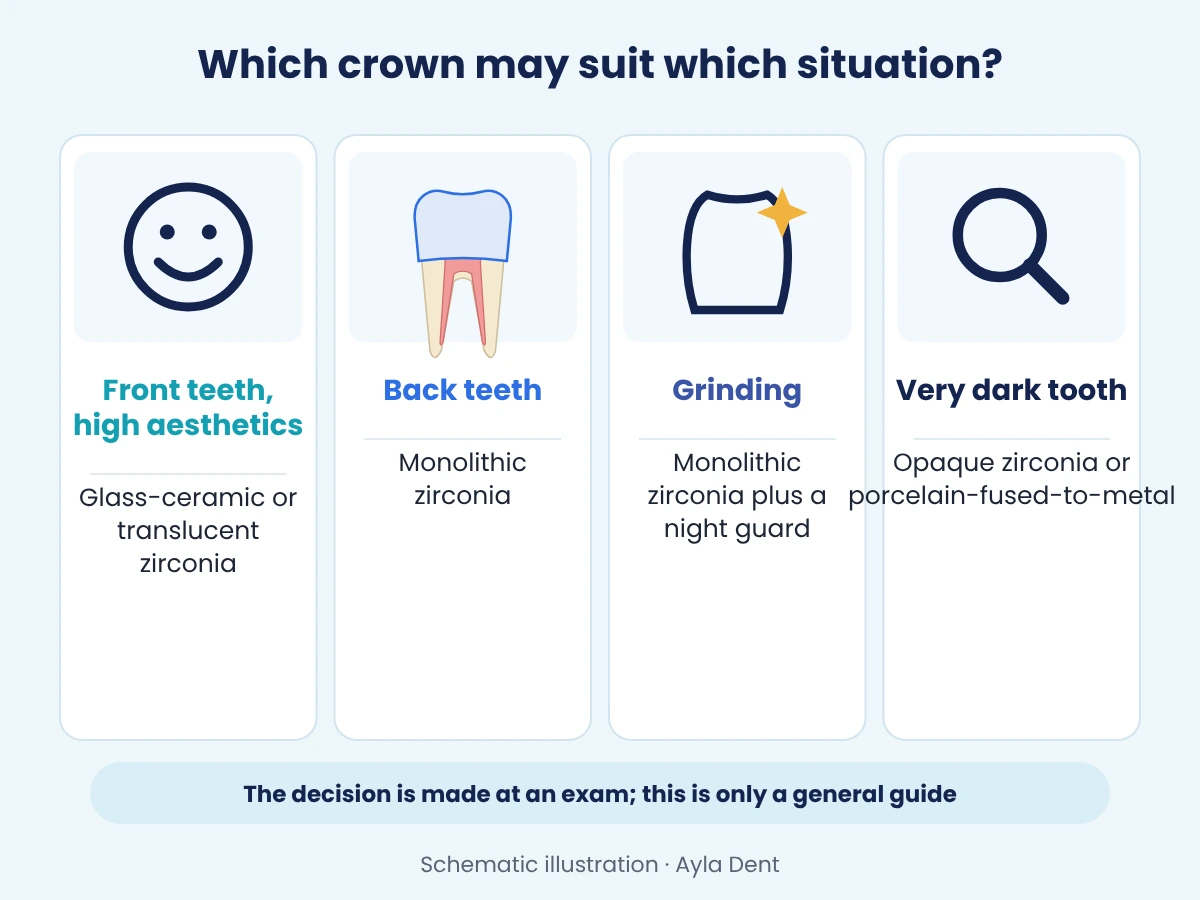
| Situation | Option that may suit |
|---|---|
| Front teeth, high aesthetic demands | Glass-ceramic or high-translucency zirconia |
| Back teeth, heavy chewing forces | Monolithic zirconia |
| Clenching or grinding | Monolithic zirconia, with a night guard |
| Tooth heavily darkened after root canal treatment | More opaque zirconia or porcelain-fused-to-metal |
| Prefers no metal | Zirconia or glass-ceramic |
| Long bridges | Porcelain-fused-to-metal or zirconia, case by case |
This is only a general guide. The decision is made after an exam.
Before Choosing a Crown
Crowning a healthy tooth purely for looks means losing more tooth than necessary. For healthy front teeth with colour or shape issues, less invasive options such as whitening, composite bonding or veneers may come first.
If a crown is needed, see Zirconia Crowns for more on zirconia types and strength.
Aftercare
Whatever the material, how long a crown lasts depends on how you look after it:
- Brush twice a day with fluoride toothpaste
- Clean crown edges with floss or an interdental brush
- Wear a night guard if you grind
- Keep up regular check-ups
Frequently Asked Questions
Which lasts longer, zirconia or porcelain?
Five-year survival is similar. Monolithic zirconia, though, chips far less often.
Why does the gum look grey around a porcelain crown?
With porcelain-fused-to-metal crowns, the metal framework blocks light, so a grey shadow can show where gums are thin. If the gum recedes, the metal edge can become visible.
Does zirconia look natural?
It depends on the type and the tooth. More translucent zirconia looks more natural on front teeth but is less strong.
Should I replace my old porcelain crowns with zirconia?
A crown that’s working well doesn’t need replacing just because of the material. Each replacement can cost a little more tooth. Replacement is considered if there’s a poor fit, decay, a fracture or an aesthetic problem.
Summary
Zirconia and porcelain-fused-to-metal crowns have similar 5-year survival. Monolithic zirconia stands out for low chipping, and metal-free ceramics avoid the metal edge and grey shadow. The right choice depends on the tooth’s position, your bite, any grinding habit and your aesthetic goals.
This article is for general information. It does not replace an examination.
Sources
- Pjetursson BE, Pitta J, Balet A, Bjarnadottir GR, Sailer I, Romandini P. A Systematic Review and Meta-Analysis Evaluating the Survival, the Failure, and the Complication Rates of Metal-Ceramic, Veneered and Monolithic All-Ceramic Tooth-Supported Single Crowns. Int J Prosthodont. 2026;39(3):308–324. doi:10.11607/ijp.9633
- Romandini P, Pjetursson BE, Pitta J, Sailer I et al. A Systematic Review and Meta-Analysis Evaluating the Survival, the Failure and the Complication Rates of Metal-Ceramic, Veneered and Monolithic All-Ceramic Tooth-Supported Multiple-Unit Fixed Dental Prostheses. Int J Prosthodont. 2026;39(4):444.